Gracias
a Edita Nómada y a Uberto Stabile , así como a nuestros amigos Francisco Pérez Belda y
Sefa Guerrero por darnos la oportunidad este fin de semana de presentar nuestra
nueva Revista de Poesía Visual y Experimental MíraM y de encontrarnos con
tantos amigos y gestores culturales de muchas partes de España que hacen
posible que lo cultural siga alimentándonos. (Myriam Muriel Mercader)
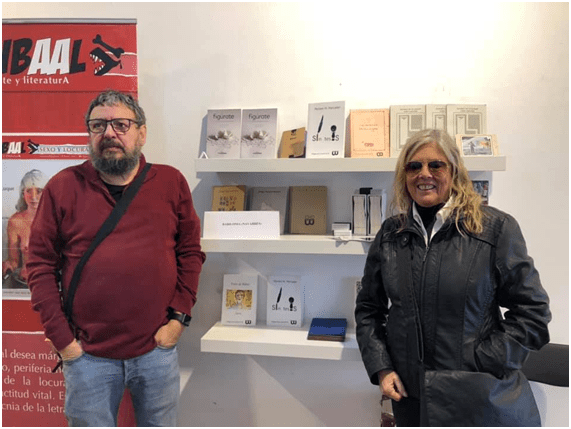
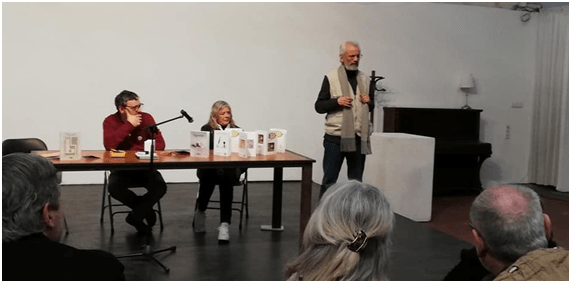
Paco Pérez Belda y Myriam Mercader en el stand de Babilonia Presentando el Pliego de la Visión nº 97 editado por Babilonia. En la foto Paco Pérez Belda, editor y Myriam Mercader, poeta visual. Paco Pérez Belda, Myriam Mercader y César Reglero presentando MíraM
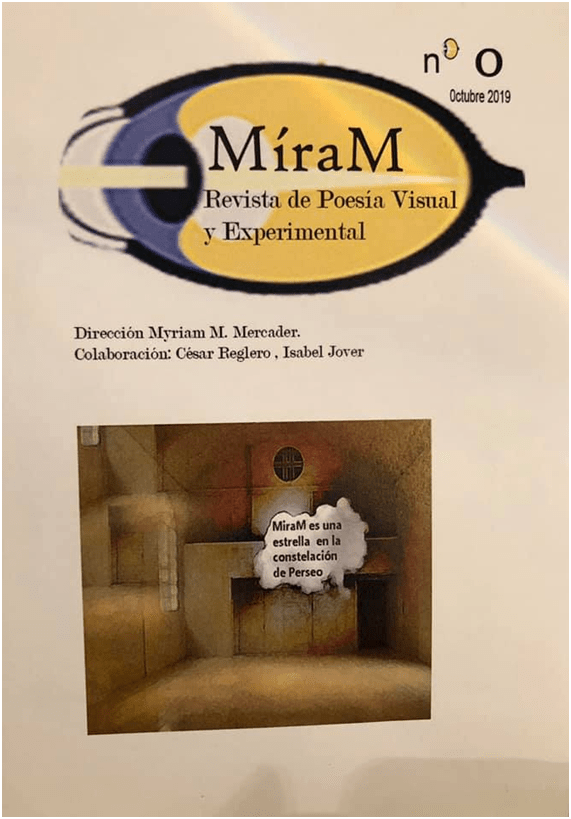
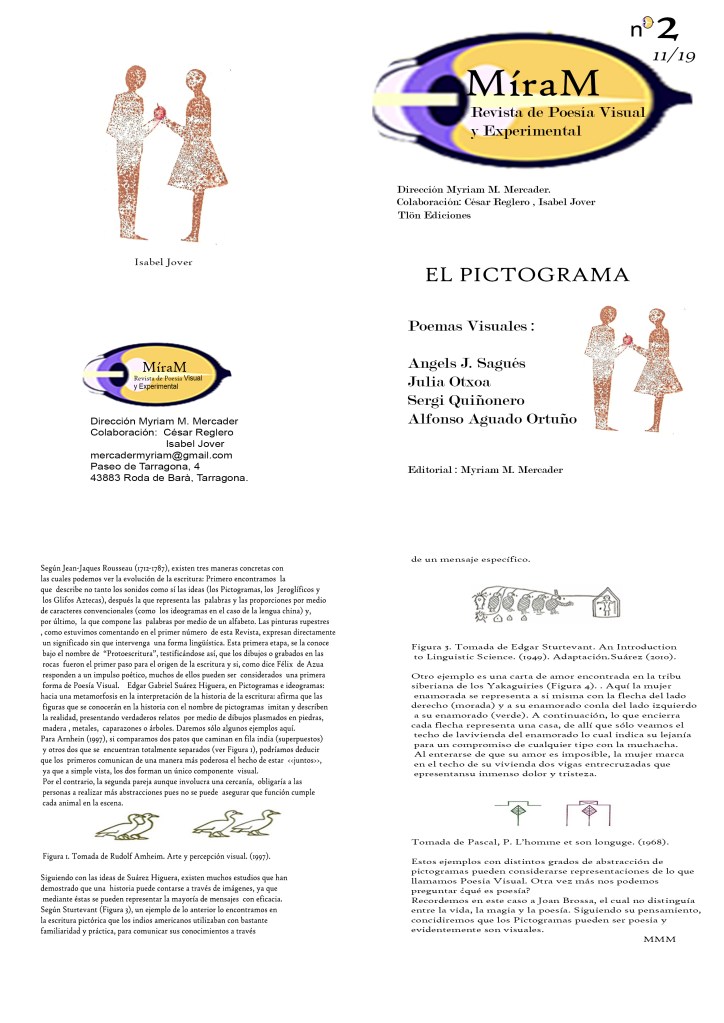
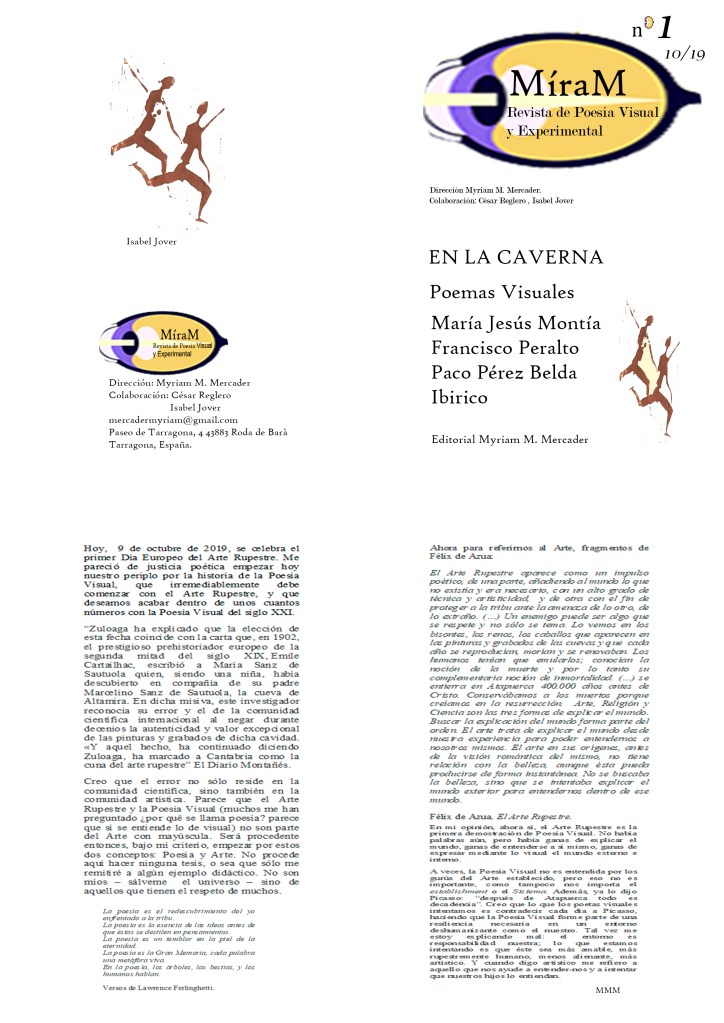
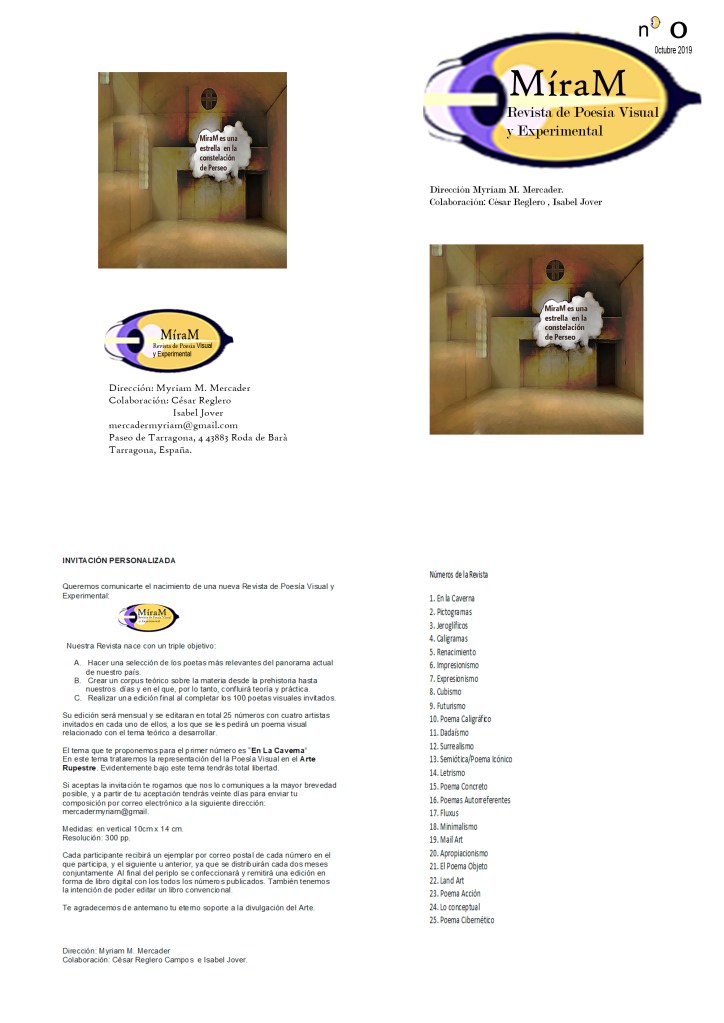
Se presentó el número “O” donde figura una declaración de intencionesde la revista, así como el n.1 y el n.2 que completarán un total de 25 que finalizarán con la edición de una edición que recogerá todas las publicaciones en su aspecto teórico y práctico.
Acto de hermananamiento con el BCD Centro de Documentación Babilonia
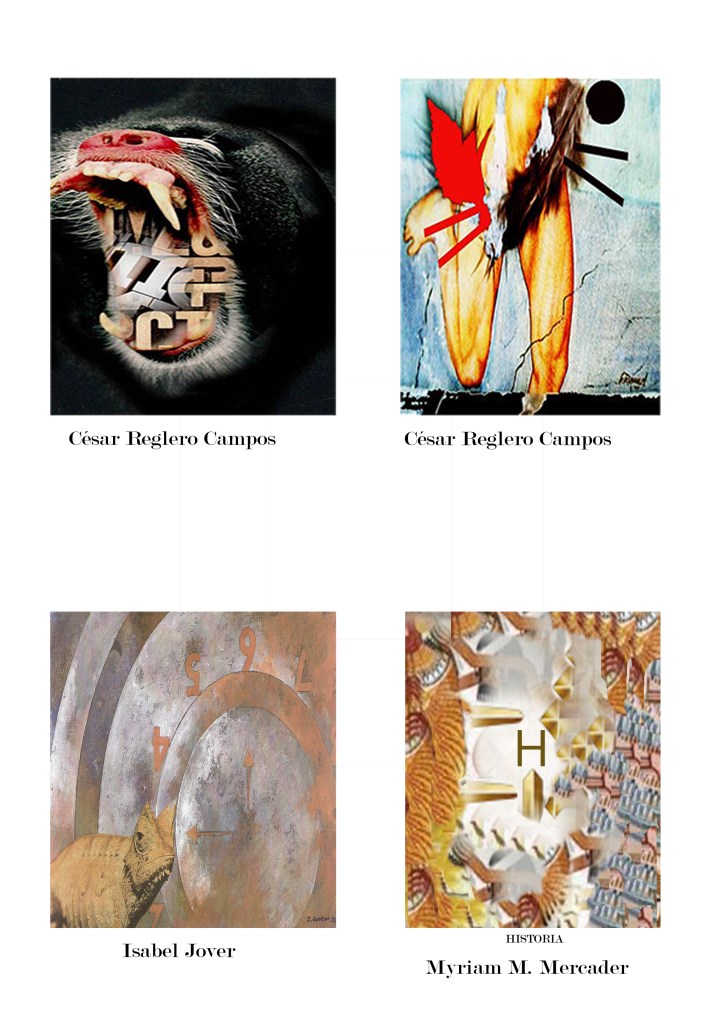
En el número Cero, que reproducimos abajo, tan sólo damos una explicación de los objetivos de la Revista mediante la Invitación Personalizada que se enviará a cada artista invitado y la relación de todos los números que se publicaran. Como se explica además de lograr reunir, a través de 25 números, a los 100 artistas que en nuestro criterio son los más relevantes de la actualidad en España, pretendemos vislumbrar motivos de Poesía Visual en ciertos períodos de la historia del arte. Cada período tendrá un número en la Revista. Los autores serán invitados según nuestro criterio por su adecuación a dichos períodos. Por otro lado los poemas visuales que aparecen en este número Cero son un juego visual de los que creamos la Revista.
El MIDECIANT en conmemoración de su 30 aniversario
invita a creativos de todo el mundo y a quienes quieran incorporarse a la
iniciativa, a participar en la “I CONVOCATORIA
ARTE POSTAL | MAIL ART”.
Todas las obras recibidas formarán parte de la
colección de Mail Art del Museo Internacional de Electrografía, MIDECIANT.
Envía tus postales con temática libre, que puedes
crear con los materiales y técnica que quieras, y en las que puedes intervenir
libremente. Los trabajos serán presentados en la exposición “ARTE POSTAL EN LAS
COLECCIONES DEL MIDECIANT-UCLM” que tendrá lugar en la Sala Acua, Cuenca,
España. Del 14 de Junio al 26 de Julio de 2020.
no dinero | no selección | no jurado |
no devolución
Dirigido: a artistas, diseñadores y público en general.
Tamaño: máximo DIN A4 (297 x 210 mm)
Envío: POR CORREO POSTAL (no se aceptarán postales enviadas por otro medios). Con sello postal de manera tradicional o en un sobre con la dirección, (SI NO TIENE MATASELLOS, NO VALE):
“I CONVOCATORIA
ARTE POSTAL | MAIL ART”. MIDECIANT. Museo Internacional de
Electrografía. Edificio Antonio Saura, Campus UCLM. C/ Santa Teresa Jornet, s/n
16071 Cuenca, SPAIN.
Técnica: libre escribe, dibuja, pega, corta, cose, rasga, imprime, haz collage, grabado, pinta, fotografía… o aquello que tu imaginación te impulse a crear…
Identificación: pon tu nombre y apellidos, dirección, país y email.
Fecha límite: se recibirán postales hasta el 31 de Marzo de 2020.
Estamos muy contentos de poder contar que hace unos meses
recibimos varias obras de Alfonso Aguado, entre las que encontramos un ejemplar
del nº 27 de la revista ensamblada de poesía visual “La Jirafa en Llamas” además
de varios libros de poesía visual y cuadernos llenos de collages.
El MIDE agradece la llegada de esta magnífica colección, además del interés de
Alfonso Aguado y la confianza depositada en nosotros para preservar y difundir
su obra. ¡Gracias por contar con nosotros!
We are
very happy to tell you that we have received several works by Alfonso Aguado
for a few months, which we find a copy of No. 27 of the assembled magazine of
visual poetry “La Jirafa en Llamas” as well as several books of visual poetry
and notebooks full of collages
MIDE appreciates the arrival of this magnificent collection, in addition to the
interest of Alfonso Aguado and the confidence placed in us to preserve and
disseminate his work. Thanks for having us!
Hoy celebramos la Revista “40 Hojas Poéticas de 40”
Gracias a tod@s los poetas y artistas que han participado en esta modesta revista, un folio A-4, con cuatro obras y breve información. Publicaciones que salen del Proyecto El Taller de POEX. Idea y coordinación de Francisco Escudero. Edita la Biblioteca Municipal de Berja-Rocío Domínguez. El objetivo fue sacar la poesía experimental de Internet, devolverla al papel y que respirara, para dar a conocer sus múltiples facetas y estilos, en el Taller y fuera de éste, mediante envíos. Una Revista gratuita y de tirada limitada a 40 números cada una. Se publican dos o cuatro revistas al mes. Esta aventura comenzó el 8 de noviembre de 2017. Podéis ver todos los números en la Biblioteca Municipal de Berja-Archivo de Poesía Visual y también a través de este enlace:
En estos 25 encuentros celebrados, en Edita han intervenido 3.600 participantes, procedentes de todas las regiones y comunidades españolas, y de otros 18 países europeos e iberoamericanos, en representación de 732 editoriales, de las cuales, 175 fueron andaluzas. Gracias a la originalidad del formato, dinámico y experimental, y a la viabilidad que supone el bajo coste de producción, Edita, que mantiene su sede matriz en Punta Umbría, se ha convertido en una suerte de franquicia cultural, abriendo sedes y celebrando encuentros en otros países del área iberoamericana, exportando así el modelo de gestión y con él, la difusión y el conocimiento de nuestra cultura y territorio. La implantación de Edita en América latina comenzó con la asistencia cada vez más numerosa de editores americanos a Punta Umbría. En el año 2010, Edita se establece en Ciudad de México, concretamente en la delegación de Coyoacán, con sede en la Casa Museo León Trotsky, y posteriormente, en el año 2011, en Colombia, en el Municipio de Sabaneta en el área metropolitana de Medellín. En el año 2012 le siguieron las sedes en Cuernavaca (México) y en el municipio de Itagüí (Colombia). En la actualidad está previsto la inauguración de nuevas sedes en las ciudades de Santo Domingo (República Dominicana) y Cerquilho (Brasil).
A lo largo de sus 25 ediciones Edita ha logrado formar, gracias a la
generosidad y compromiso de los participantes, un patrimonio bibliográfico que
cuenta con más de 15 mil publicaciones especializadas, con sede en el Centro
Cultural de Punta Umbría, cuyos fondos han servido para alimentar muestras y
exposiciones en reconocidos espacios nacionales e internacionales del arte y la
cultura, como el MACBA, Museo de Arte Contemporáneo de Barcelona, La Casa
Encendida de Madrid, el Centro José Guerrero de Granada, el Centro de Arte
Contemporáneo de Sevilla, el CECUT Centro Cultural Tijuana de Baja California
en México, y en la Casa Museo Jardín Borda de Cuernavaca, también en
México.
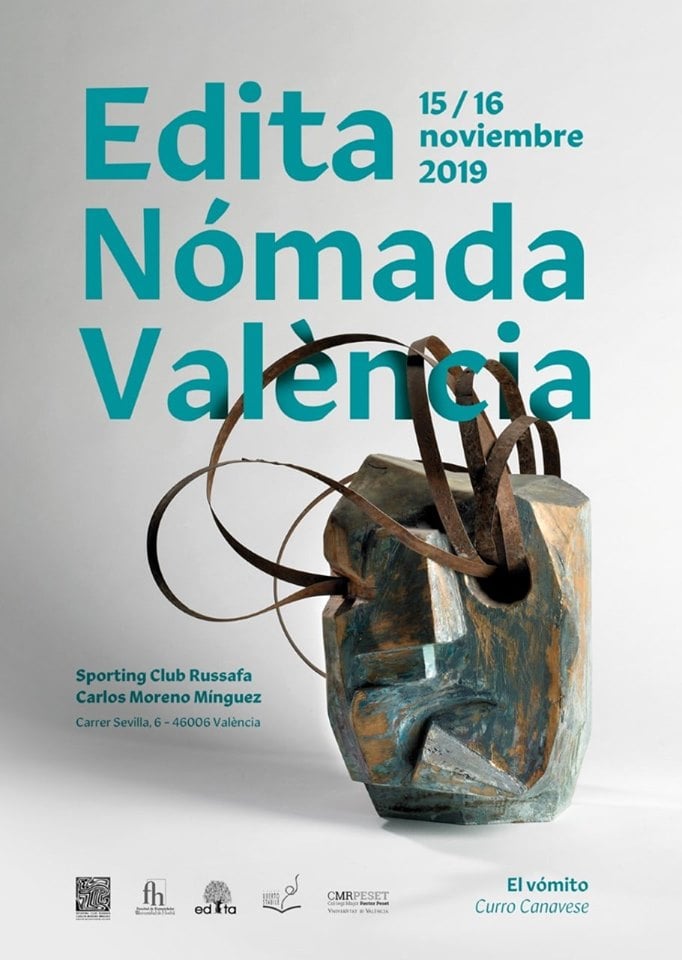
Continuando con el modelo de difusión y promoción de Edita y para
conmemorar los 20 años de existencia, ha nacido igualmente Edita Nómada, una
exposición itinerante de los fondos bibliográficos, carteles y fotografías del
encuentro, así como la celebración de conferencias, mesas redondas, recitales y
la proyección de un documental sobre el proyecto en las diferentes ciudades por
donde discurrirá la muestra a partir de este mes de mayo: Barcelona, Valencia,
Sevilla, Granada, Bilbao, Málaga, Huelva, Moguer, Cáceres, Córdoba y
Monachil, Lisboa, Loulé, así como en las diversas sedes americanas del
encuentro.
El pasado mes de enero se hizo entrega en Jaén, al proyecto EDITA, el Premio
Progreso Andalucía 2012, otorgado por la Fundación para el Desarrollo de los
Pueblos de Andalucía, la FAMP y la Consejería de Presidencia y Administraciones
Locales de la Junta de Andalucía. Desde el inicio, Edita ha contado con el
apoyo y la colaboración de la Consejería de Cultura y Deporte de la Junta de
Andalucía.
El Alcalde de Punta Umbría ha destacado la celebración de este evento en el
conjunto de actos programados para la celebración del 50 aniversario de la
independencia del municipio costero y ha acentuado su importancia desde el
punto de vista de la promoción cultural y turística de Huelva en el
exterior. En este sentido ha valorado » la eficaz gestión de los
recursos en estos momentos de austeridad económica» y la apuesta del
Ayuntamiento por la Formación y la Cultura como pilares de desarrollo.
Vicente Zarza ha vinculado la colaboración de la Junta con
EDITA al Pacto Andaluz de la Cultura, impulsado tras el
trabajo conjunto de la Junta de Andalucía con diversos ámbitos y sectores
culturales, como una apuesta institucional por la cultura como valor
identitario de Andalucía, que apuesta por las raíces y la tradición pero
también por las vanguardias y la innovación, procedentes de diversas culturas,
tal y como requiere una sociedad abierta al mundo, sin perder su perspectiva
propia que tenemos como pueblo.
David Leavitt’s “Gravity” seen from diverse critical
perspectives.
Abstract
This paper aims to approach Davit Leavitt’s “Gravity” from diverse
critical perspectives, namely, Formalism, Structuralism, Marxism, Feminism and Psychoanalytic
literary criticism. It is an academic task while it must be born in mind that
reading is a versatile and many-layered activity that will never be fully
accomplished by means of only one critical perspective but by a kaleidoscopic joint
approach encompassing all of them. The story has been chosen from Joyce Carol
Oates’ anthology The Oxford Book of American Short Stories because it is
a superb example of how literature works: making language non-automatic,
condensing in a few pages a universal myth, showing how feelings are translated
into material commodities and finally depicting how people struggle to ultimately
disembowel their identities, eventually discovering that they are far from the
socially accepted canon and in desperate need of any small victory over universal
gravity.
A Multi-critical Perspective of David Leavitt’s “Gravity”
For its study the story has been divided into four parts, the two initial paragraphs marked [1] and [2], a central body of mainly dialogue: [3] and the final paragraph: [4].
[1] In the opening of the story the reader is confronted with the choice Theo had to take. A STRUCTURALIST critic who analyses the units of a system and the rules that make that system work will notice the linear syntacmatic sequence of the two possibilities:
a drug that would save his
sight
and
a drug that would keep him
alive
They are identical
but for the last three words in both phrases which imply an opposition though
using two verbs with similar meaning: save and keep. A logical analysis concludes
that what will save his life will make him ‘not keep’ his sight. The conflict was resolved by Theo choosing
‘not to go blind’. A FORMALIST critic will notice the antithesis and how the
author makes the construction ‘unfamiliar’ by not repeating one of the
propositions of the alternative, therefore increasing the difficulty and length
of the perception because “the process of perception is an aesthetic end in
itself and must be prolonged” (Shklovsky 18). Considering this same last
phrase, a STRUCTURALIST critic will further argue that “not to go blind” is
more than just the opposite of “to go blind” or ‘lose his sight’ for as “J. A. Greimas
has illustrated with his squaring of the opposition any semiotic system of
contrasting elements also imply the negation of each term in the binary”
(Felluga, 3), a contradictory pair, which in this case would be “non-to go
blind” and “non-not to go blind”. As the “bond between Signifier and Signified
is arbitrary” (Sausurre, 79) thus there can exist more than one Signified for
each Signifier, leading to multiplicity of meanings. In our case ‘ not to go
blind’ meaning not only to retain sight but be able to see- possibly more than
just the physical environment eventually grasping the ultimate reason of Theo’s
circumstance.
He stopped the
pills
and started the injections
these required the implantation of an ( ) above his heart
and within a
few days
the clouds in
his eyes started to clear up
he could see again.
A FORMALIST critic
echoing Osip Brik would say that the rhythm and stress in Leavitt’s prose
(which can be noted throughout the text) “are only the obvious manifestation of
particular instances of basic euphonic laws” and that “the figures play an aesthetic
role in its own right” (qtd. in Eichembaun, 9).
If we turn to what
a PSYCHOANALYTIC critic would have to say, we will immediately highlight the fact
that psychoanalytic literary criticism begins with Freud himself who “notices
that literary texts are like dreams that express unconscious material in the
form of complex displacements and condensations ( ) literature displaces
unconscious desires, drives, and motives into imagery that might bear no
resemblance to its origin but that nonetheless permits it to achieve release of
expression” (Rivkin and Ryan, 125). For Freud, in ‘The Uncanny’, fear for
castration takes the form not of a literal image, but of a metaphoric
substitute that displaces the protagonist’s anxiety onto a fear of losing his
eyes (160) and Theo’s choice can be taken as a flagrant example.
A STRUCTURALIST
critic will note then that this opening paragraph refers to the first plot
element – fright to lose his sight – as well as points out one basic “mytheme”(Lévi-Strauss,
104) in the laying out of the Oedipus complex-myth which the rest of the story
will further develop and which the reader can predict due to Leavitt’s
hermeneutic narrative: the reader knows from the beginning that Theo chose to
die and for a FORMALIST critic the story will then keep the reader’s interest making
him/her want to know how this will happen. The voice we hear is that of a
limited omniscient narrator, the FORMALIST critic would also point out: the
writer adopting the stance of an impersonal consciousness, itself not an agent
in the events of the story but able to observe the thoughts of one of the
characters. In our story it first seems to be narrating from Theo’s perspective.
But soon we realize it is really Sylvia’s feelings which are put through from
inside, while Theo is seen from an outer perspective. It will not be until the
last paragraph of the story that we are to deepen in Theo’s thoughts while he is
the one who tries to
analyse Sylvia’s. The FORMALIST critic will also point
out the use of analepsis or flashback taking us back to Theo’s childhood in the
third sentence of this first paragraph.
The anecdote depicted presents Sylvia – his mother- for the first time.
The Psychoanalytic critic will immediately observe the powerful mother-character
shaping the Oedipus complex/myth. The boy does not want to admit he needs
glasses and his mother, who gave him birth, who called him Theo (God) shoves her own harlequin glasses onto his face
(in the same impulsive way she will later toss the bowl to him) not caring what
people would think because he can finally see.
A FEMINIST critic is bound to note the family-rearing role the story
gives to Sylvia as well as her influence in Theo’s personality. Moreover, the
same critic will abound in noting that Sylvia has suffered an inmasculating
process taking on her back the task of further protecting her child as well as
bringing him up. A FORMALIST reading of the last phrase of the paragraph: ‘he
could see’ will highlight that it is a sort of antistrophe taking us back to
the previous ‘he could see (again)’ and further clarifying it: Theo had been
deprived of sight in an earlier stage of his life and it had been his mother
who had given him sight. Thus the ultimate purpose of the analepsis is to let
the reader know how it had been the same when Theo was twelve: his mother
protecting him – enhancing his sight. A
PHYCHOANALITIC critic would argue that Theo had not been able to acquire his
gender identity, not learning to give up his mother and identify with his
father. It can be noted again how the idea of fear of castration takes the form
of fear of losing his sight. Immediately a FEMINIST critic would point out that
Sylvia feels it is her duty to deprive herself of her own sight during the projection
of the film in order to allow her son to watch it.
[2]
The same idea is
further outlined in the second paragraph which starts: ‘Because he was dying
again, Theo moved back to his mother’s house in New Jersey.’ A FORMALIST critic will point
out the paradox of the situation. Cleanth Brooks explained in “The Language of
Paradox” that paradox is the appropriate language of literature (58). The
writer gives us a blurred impression that by helping him regain his sight once
more Sylvia is provoking his death as well. And that is quite so. Paradox,
though not a direct method, is the best to depict multiple implications. Sylvia
will be his nurse because having had already gone through her own mother’s
death she is fit to accomplish the same task with her son. Once more the
FEMINIST critic will note the further female role of caring and seeing through her
parent’s death in patriarchal society. The pipe stuck in his chest is the
‘constant reminder of how wide and unswimmable the gulf was becoming between
him and the ever-receding shoreline of the well’. A FORMALIST criticism will
justify the various metaphors and the subsequent contrast as a means to bring
the reader to the conclusion that Theo is definitely dying and that realizes it.
Immediately the contrast: Sylvia is cheerful – intricately though. She takes him to the library and the museum
and shields him when his thinness and cane draw stares. A PHYCOANALISTIC critic
will continue composing the image of castrated youth, and a STRUCTURALIST critic
will see as well in Theo’s use of a cane, another mytheme, one more constituent
unit of the Oedipus myth that normally is associated with the unsteady walking
when deprived of sight.
[3]
The central part
of the story confronts the reader -the FORMALIST critic will notice- with
another strange collocation of words in the first sentence: “they were shopping
for revenge”. The skillful use of foil here is a crucial part of the writer’s
repertoire. Setting things in systematic contrast to each other is one way of
drawing intense attention to details the writer refuses to spell out because
spelling things out would dilute the flow of events. A STRUCTURALIST critic
will argue on his side, following Sausurre that because language is a system of
interdependent terms in which the value of each term results solely from the
simultaneous presence of the others, the reader must stop and think in all the
weak meanings ‘shopping for revenge’ arises. But the most emblematic analysis
could come from a MARXIST critic who will logically conclude that shopping
refers to the act of acquiring a commodity, which by definition is “an object
outside us, a thing that by its properties satisfies human wants of some sort
or another” (Marx, 268). For Sylvia this want is ‘revenge’ and the MARXIST
critic will further claim that as the utility of a thing makes it a use-value, therefore,
the commodity to be bought by Sylvia will have a high use-value because revenge
–for Sylvia- is very useful.
To Sylvia’s phrase
“Ah, you live an learn” Theo replies ironically: “You live” The use of irony
here will lead the PSYCHOANALISTIC critic to the conclusion that it is a
symptom of Theo’s blaming his mother for his dying, and the fact that he makes
her see him through his last days is a punishment.
Sylvia reminds
Theo how Bibi had given him a ‘cheap little nothing’ for his graduation and, on
his side, Theo comments on his giving as
a wedding present to his roommate Nick a five-dollar garlic press which reflected exactly how much he felt his
friendship was worth at that moment. The MARXIST critic will note the use, once
and again, of commodities to express feelings. The interesting part of the
question it poses is how people get to permeate commodities with such abstract
characteristics. The analysis of both MARXIST and PSYCHOANALISTIC criticism come
to be very close regarding this matter. “According to Lacan, it was none other
than Karl Marx who invented the notion of symptom” (Zizek, 312). There is no
doubt a fundamental homology between the interpretative procedure of Marx and
Freud. As Slkavoj Zizek puts it in The
Sublime Object of Ideology “we must accomplish the crucial step of
conceiving the hidden “meaning” behind the commodity-form, the signification
“expressed” by this form; we must penetrate the “secret” of the value of
commodities” (313). Sylvia had been looking a long time for “something heavy
enough to leave an impression, yet so fragile it could make you sorry” and she
found it materialized in a bowl worth four hundred and twenty-five dollars.
What mattered least was if it was beautiful or ugly, that was not the case.
Both the MARXIST and the PSYCHOANALYTIC critics will hint the “Fetishism”
(Marx, 271) attached to the bowl. While
the latter will explain it as a part of a process of exorcism, the former will
realize that “there is a definite social relation between men that assumes, in
their eyes, the fantastic form of a relation between things” (Marx, 271). Hence the productions of the human brain
appear as independent beings endowed with life and interacting in the world of
commodities with the products of the men’s hands. And that Marx called “Fetishism”.
But it is not
enough that Theo sees the bowl, he has to feel it – Sylvia suddenly argues -and
unexpectedly tosses it to Theo like a football. She effects the sudden movement
in the same manner twelve years before she had shoved her glasses onto his
face. Her action obliges Theo to catch it and though it sinks his hands and makes
his cane rattle in the floor, he succeeds in catching it. Our STRUCTURALIST
critic is bound to find coherent that following the rules of the Oedipus myth, Sylvia,
helping him not to go blind, is showing him with her action he can oppose
gravity, that universal force. No need anymore for a cane that can be left, if
even for a moment, rattling on the floor. That sole instant will prove the PSYCHONALYSTIC
critic that unconscious forces can be defied; a person may defeat the psychic
censorship if given the opportunity of “activating the repressed wishful
impulse sending it into consciousness in a disguised and unrecognizable substitute”.
(Baker).
[4]
A FEMINIST
analysis of this last part of the story will notice how Sylvia is depicted
through a number of characteristics that “phallocentric order” (Mulvey, 586) traditionally
have awarded women with. Sylvia “squeezed
her eyes shut so tight the blue shadows on her lids cracked”; furthermore “on
the surface things seemed right. She still broiled herself a skinned chicken
breast for dinner every night, still swam a mile and a half a day, still kept
used teabags wrapped in foil in the refrigerator”. Everything is right because
Sylvia continues embarking herself in all the activities patriarchy has imposed
women in order to give pleasure when looked at. Laura Mulvey noted in “Visual Pleasure and
Narrative Cinema”: “In a world ordered by sexual imbalance, pleasure in looking
has been split between active/male and passive/female” (589). A woman has,
therefore, to be a passive image of visual perfection. It is basically what a
MARXIST critic would call keeping the use-value of women and what one of Lévi-Strauss’ theories would explain: “as the
exchange of women is a fundamental principle of kinship, the subordination of
women can be seen as a product of the relationships by which sex and gender are
organized and produced” (qtd. in Rubin, 544).
The FORMALIST
critic, on his end, would mark the use of the hyperbole for emphasis in “she
squeezed her eyes shut so tight the blue shadow of her lids cracked” as well as
the metaphor in “that gleam of flight and regret” when referring to the bowl
which is so oblique it can only be wholly understood if referred back to “so
fragile it could make you sorry” at the end of part [3].
Theo in a last and
perfect state of clarividence understands that his mother was trusting “his two
feeble hands, out of the whole world, to keep it from shattering. ‘What was she
trying to test? Was it his newly regained vision? (.) that he hadn’t slipped
past all her caring, a little lost boy in rhinestone-studded glasses?” A
PSYCHOANALISTIC critic would argue that Leavitt has made his character act
himself as a psychoanalist, wondering about both Sylvia and himself and there
mutual close relationship, until he finally experiences an epiphanic instant which
a FORMALIST critic would argue qualifies him as a dynamic character undergoing
a radical change in his self-identification. The epiphany is in the closing of
the story when Theo recalls the broad smile of his mother and he realizes that
in that war, they were both engaged in, between heaviness and shattering, “he
had helped her win some small but sustaining victory”. Our STRUCTURALIST critic
would mark, once again, the use of foil but this time in an oblique and subverting
way contrasting, as in the two sides of a war, heaviness and shattering when
really one is but the consequence of the other. On his end the FORMALIST critic
would claim that foils offer the writer interested in psychological or social
realism a way of maintaining the illusion of reality while at the same time the
crucial distinction between art and life is not lost, achieving as a result a
much clearer situation in literature than what can be experienced in real life.
To conclude this
multi-perspective literary criticism, we can turn to the FEMINIST criticism
once more: Sylvia exercises the power the myths of sexism make available to
her, and pushes Theo to oppose gravity, but that power is minimal because it
only is the power of inducement. It is her son/male who really executes the
action. The merit is his; Sylvia – the female- being just a tool, an object by
which Theo- the dominant male- achieves victories.
“Gravity”, as any
other narrative, has as many readings as readers it may attract, and therefore,
as many critical perspectives as existing theories can be drawn to discussion.
In any case what cannot be denied is that it is a powerful and disturbing
narrative that brings to surface many present questionings including such a delicate
case as ‘AIDS’ which is only implied throughout the story but nonetheless very
present.
WORKS CITED
Baker, Lyman A.
“One of Freud’s Analogies for Explaining the Idea of Repression”

















 El blog de Myriam M. Mercader