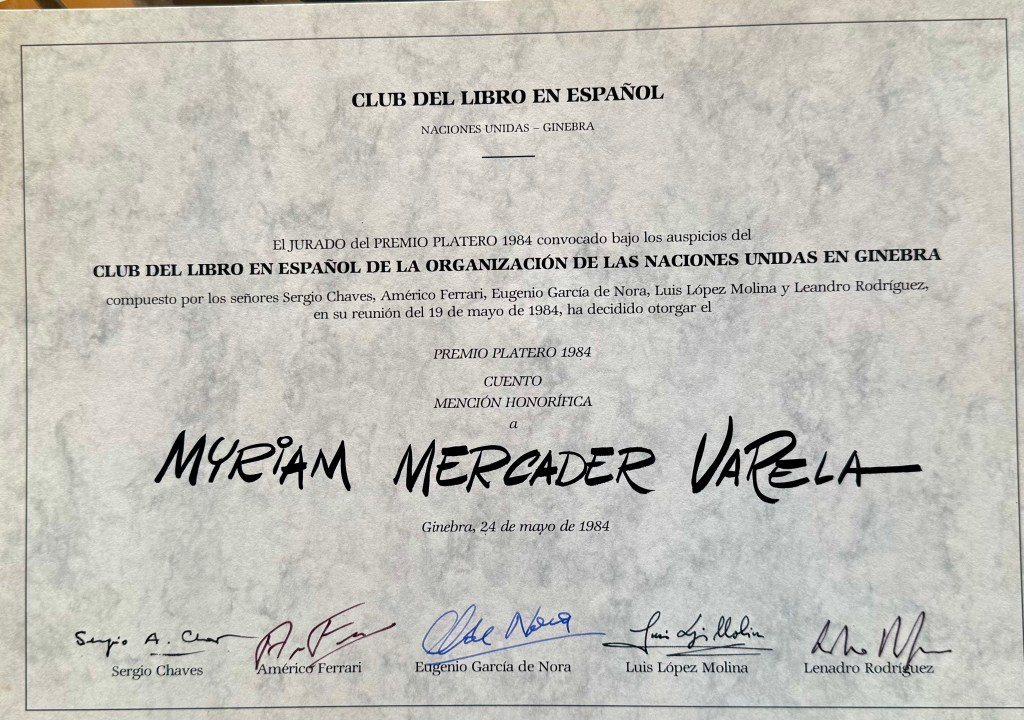
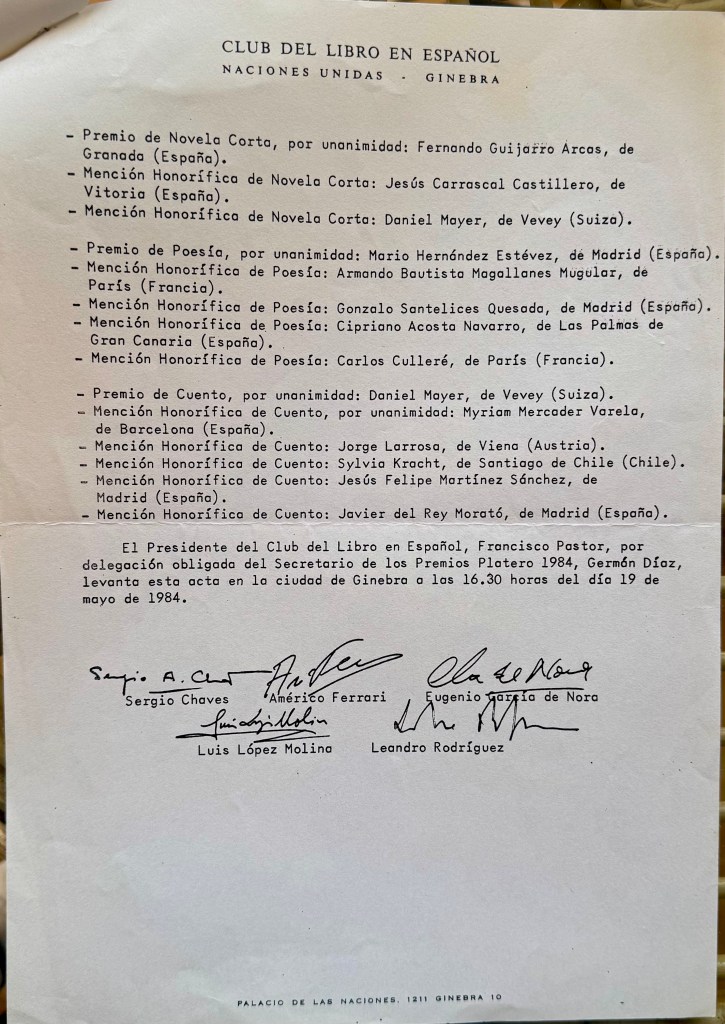
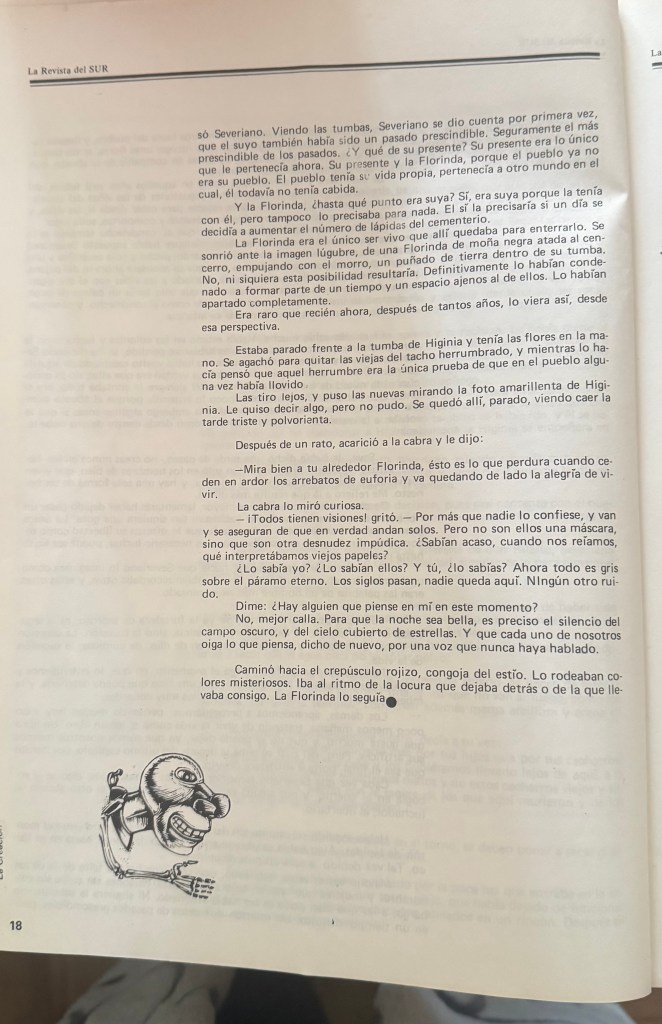
En mayo de 1984 le fue otorgado el Premio Platero de Cuento por el Club del Libro en Español de las Naciones Unidas en Ginebra.
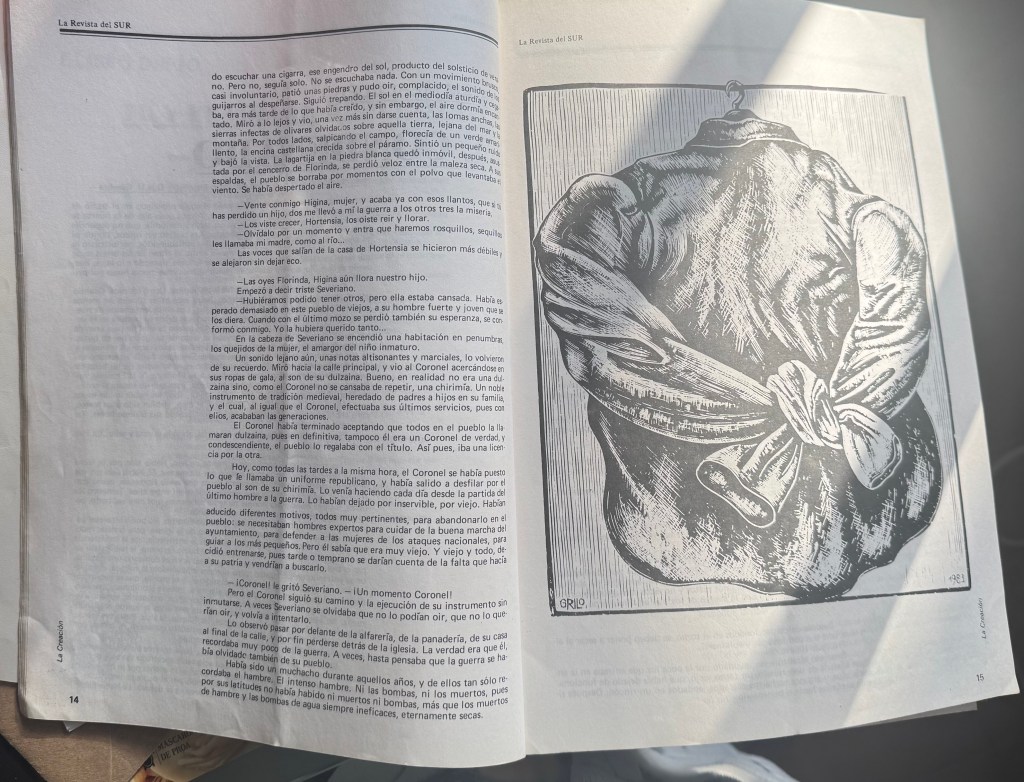
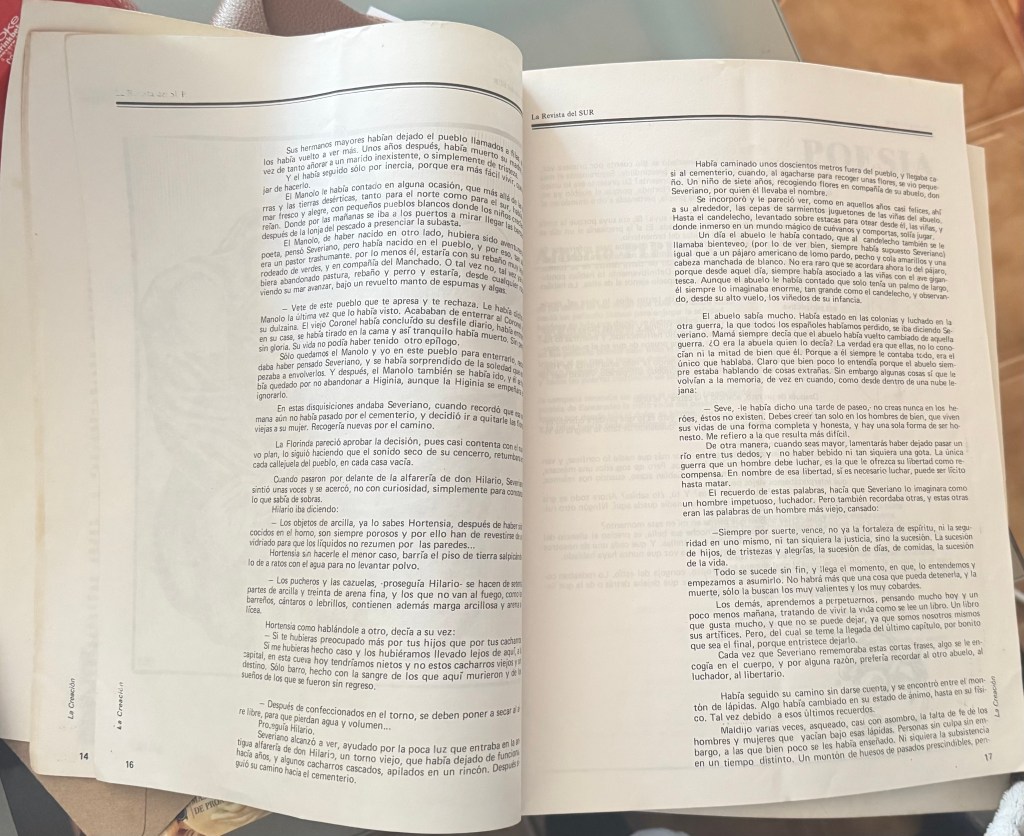
El Relato premiado fue : El Condenado publicado en la Revista del Sur nº3-4 1985.
En 2020, en plena Pandemia de Covid, La Casa de Uruguay en Barcelona organizó un certamen literario. Andrea Arismendi ganó el Primer Premio con su relato El Huésped y Myriam Mercader el Segundo Premio por La Brecha. Se puede ver la entrega de premios en este blog bajo el título de II Premio de Relatos La Casa que Escribe, del 6 de agosto 2021.
Tobatymbá se muere. Está tendido en su lecho y piensa, recuerda, afiebrado delira.
“Ahaquimañomo” le ha dicho a su mujer Amambai en lengua tupí. Luego para sí en español “Voy a morir.”
Su frente ancha, labrada por los años destaca en una cara huesuda. La cabellera larga, que un día fue rubia y ahora cana, se esparce por la almohada. Tiene el rostro serio y sus ojos, antes de un azul penetrante, se achican mostrando un gris profundo que refleja una vida de pérdida y de sufrimiento. Alrededor se ciñe la sombra silenciosa de la selva, solo las hogueras alumbran las siluetas. La aldea permanece casi dormida. El ñacurutú en la rama, despierta y observa, el urutaú lo secunda. No ha acudido la luna.
Amambai lo cuida sin descanso, y mientras el hombre evoca bajo sus párpados figuras de una larguísima vida y sus ojos enrojecen, Amambai revive las historias contadas una y mil veces por su marido, que de repente, es Herman el niño.
Herman, era hijo de una familia de inmigrantes, que después de mucho rodar, había atravesado el Atlántico para terminar con sus bultos y sus hijos en la Banda Oriental. Venían de tierras frías y lejanas, cargados de tradición y de una férrea religión que había acabado por agobiar al chico.
El muchacho había crecido en un pequeño pueblo del Uruguay, sin embargo, su físico lo delataba y siempre tenía a chicas locales embelesadas por sus rasgos nórdicos. En su adolescencia le había bastado esa popularidad y la moto, que había comprado con los réditos de trabajos que de vez en cuando hacía en algunas de las chacras de los alrededores de Ecilda Paulier.
Cuando los años pasaron, fue a estudiar a Montevideo en una institución agrícola protestante de prestigio, para aprender a llevar la granja de sus padres. Se le daba muy bien, pero Herman necesitaba más aventura, más libertad. O sea, independencia de su familia y de un destino gris en un pueblo pequeño.
“Independencia” pensó Amambai. Con los años Herman, Tobatymbá para su tribu, le había explicado lo que eso significaba para el hombre blanco. En realidad, a ella le costaba digerir el término. ¿No eran ellos independientes tal y como estaban? Siempre lo habían sido. Sin embargo, su marido le había explicado que en Montevideo había una plaza con ese nombre para recordar a todos los habitantes lo difícil que había sido lograr y conservar la independencia. También le había contado que, con el tiempo y la edad, él había razonado que la independencia no se logra fácilmente, siempre dependemos de otros, u otros dependen de nosotros, lo que es otra forma de carecer de independencia. Amambai se reía cuando su marido decía esas cosas. Pero, ahora viéndolo sudar y atenazado por una fiebre feroz, lo miró preocupada.
Tobatymbá se remueve inquieto, el sudor le corre por el rostro y Amambai derrama la que sería su última lágrima. Se iba a dedicar a ayudarlo sin permitirse sentir flaqueza alguna ni darle a su marido otro motivo de sufrimiento.
Esta era la segunda vez que lo veía enfermo en cincuenta años de vida en común. La primera, la vez que apareció flotando en el río. Amambai lo había encontrado cerca, a la deriva, en una vieja canoa. Estaba moribundo y con el rostro muy pálido. Así es que lo habían llamado Tobatymbá – el del rostro blanco. Había corrido como loca en busca de ayuda. Nunca supo con claridad las razones que la habían conmovido tanto. No era la primera vez que un hombre blanco aparecía herido en el poblado, ni tampoco sería la última. Pero, Amambai, por alguna razón se había sentido responsable de aquel hombre tan indefenso. Después de socorrerlo lo había cuidado con desvelo. Por aquellos entonces ella era casi una niña. Habían sido quince días interminables, luchando contra la muerte. Pero, la madre naturaleza lo había protegido y se había salvado. Si, ella lo había cuidado todo ese tiempo y después…después lo había seguido haciendo el resto de su vida.
Amambai toma entre sus manos el rostro húmedo de Tobatymbá y sigue observándolo, mientras vuelve a revivir antiguos episodios olvidados de su larga vida juntos. Algunos eran propios, otros los que él le había contado de su pasado y de la forma en que el destino lo había llevado hasta ella.
Le había contado de Beatriz y de Adorisio, una pareja de amigos que, aunque mayores que él, lo habían acogido durante su juventud en El Chaco argentino al cual, después de sopesarlo mucho, había escapado en busca de aventuras. Herman no había querido enamorarse de Beatriz por respeto a Adorisio, pero se había encontrado incapaz de evitarlo y se había resignado a soportar su desventura de la manera más honrosa, sin dejar traslucir lo que sentía.
Al principio había sido difícil, pero con el tiempo pudo perfeccionar la mentira. Beatriz era muy amable con él y Adorisio lo trataba como a un hijo. Trabajaban juntos en la tienda que tenían en el pueblo, y así los días iban pasando, uno a uno, sin mayores contratiempos.
Cuando Herman se sentía solo, recurría a sus dibujos. Dibujaba casi todo, pero más que nada, le gustaba plasmar la selva cada vez que un papel caía en sus manos. Disfrutaba con el mundo exuberante que lo rodeaba: enredaderas, camalotes, ceibos, mburucuyás, macachines, y sobre todo la sensitiva caibobé. Caibobé, había aprendido, quería decir planta que vive, y sus hojas se pliegan al más mínimo contacto.
Mientras iba dando forma bajo su lápiz a una selva de grafito, se olvidaba de todo, y se transformaba en un inmenso creador omnipotente. Cuánto más infeliz se sentía, más se refugiaba en su selva de papel. Esto sucedía, sobre todo, cuando sentía revivir en él la pasión que le despertaba Beatriz y que, por momentos, volvía y le golpeaba muy fuerte.
Estos sentimientos se los había ido contando a Amambai a lo largo de los primeros años, cuando aún era una niña, cuando ni siguiera él sospechaba el amor que en la muchacha iba suscitando con el tiempo. Amambai se imaginaba a una preciosa rubia, divertida, que sabía del mundo fuera de la aldea y que Herman echaba continuamente de menos.
Un día de cacería, le había contado Tobatymbá, él se había apartado de la pareja para perseguir un gato montés y habiendo fracasado en su intento de cazarlo, había vuelto para sorprender, sin ser oído, a la pareja.
El pobrecito estará dejándose la sangre en la lucha para poder traerte el trofeo. ¡Juventud, divino tesoro! – había ironizado Adorisio.
Las risas hirientes de Beatriz habían festejado las irónicas palabras de su marido. La decepción de Herman nunca pudo apagar esas risas en su memoria. Y hasta Amambai se había asustado al ver su cara desencajada cuando se lo contaba. Tobatymbá había intentado no darle importancia, pero se sentía demasiado ofendido para perdonar y más dolido aún para olvidar. Así se embarcó en una vida de odio, lucha y culpa de cuyo naufragio tan solo pudo escapar mediante otro aún más grande: cuando Amambai lo encontró casi muerto en el río.
Amambai, sintió gritar desde lejos a su nieto:
¡Abuela!
Se giró, y vio que venía cargado con palos y a punto de caerse de bruces en su atropellada carrera, mientras, Tiapug, su perro, luchaba por quitarle el que más le gustaba.
Muy bien Heçacang, me alegro de que por fin te decidieras a hacer algo útil, en lugar de andar todo el día tras esos pobres animales para cazarlos – le contestó la abuela, y en su voz había un ligero tono de reproche.
El chico, saltó enseguida con la misma respuesta de siempre:
Paiamoi me dijo que pronto sería un hombre, para ello debo practicar.
Tu abuelo habla más de la cuenta – fue la respuesta de Amambai.
¿Cómo se encuentra el abuelo? preguntó preocupado el chico.
Amambai miró a su nieto y dudó un momento antes de contestar. Heçacang se parecía tanto a su abuelo, que era como estar imaginándoselo de jovenzuelo, cuando aún no lo conocía. El muchacho tenía la misma mirada transparente y azul, y en la tez morena resaltaban sus ojos como dos enormes lunas azules. Tobatymbá y ella habían tenido una sola hija. La habían llamado Toribai – grande alegría – y eso justamente había sido para ellos, una enorme alegría. Había crecido muy feliz y llegada la pubertad, como era tradición en la tribu, se había casado. Poco había tardado en nacer Heçacang, aunque menos había tardado la muerte en llevarse a su hermosa madre y al joven padre.
Abuela ¿Cómo está? ¿Puedo verlo?
Mira hapí, hijito- comenzó diciendo Amambai – Ya eres mayor para comprender ciertas cosas. Paiamoi va a morir pronto, tienes que hacerte a la idea y poner de tu parte para darle alivio.
Heçacang guardó silencio un momento y luego dijo:
Entonces, hay algo que debo hacer enseguida – y girando su cuerpo, se perdió detrás del poblado.
Amambai de pronto se sintió muy triste, se estaba quedando sola.
Los cuentos de su marido, que antes le habían provocado tanto interés, ahora la entristecían.
Aquel último año con los Rodríguez, le había contado Herman, había dibujado como nunca. Se pasaba, también, largas horas en su canoa, aprendiendo de memoria la costa del río para confeccionar el mapa que la pareja le había pedido. A veces ni siquiera llegaba a dibujarla. Se tendía boca arriba en la canoa y se perdía en la inmensidad del cielo, lejos, muy lejos, donde ni siquiera su culpa lo pudiera alcanzar.
Un día, súbitamente, Adorisio y Beatriz tomaron la decisión de trasladar el negocio a Posadas, en la costa del rio Paraná. No le dieron especiales explicaciones a Herman. Solo lo invitaron a acompañarlos, si así lo decidía.
A Herman le agradó la idea de cambiar de aires y accedió a viajar. Sin embargo, una vez en Posadas, el matrimonio no tardó en explicarle los motivos de la brusca mudanza.
Te necesitamos Herman, tenemos un buen negocio entre manos – le había dicho Adorisio mientras cenaban.
Usted dirá – había contestado, no sin cierta cautela, el muchacho.
Antes de explicártelo en detalle, debo saber si estás dispuesto a correr ciertos riesgos a cambio de una buena suma de dinero – continuó Adorisio de manera socarrona, pues creía conocer el sentido aventurero de Herman.
Diga nomás, no hay riesgo que no corra ante esa propuesta – se apresuró a contestar Herman, aun cuando en realidad no era un hombre al cual el dinero lo moviera tanto como la posibilidad de una nueva emoción.
Así, lo habían iniciado en el negocio del contrabando y, a decir verdad, no con poco éxito. Para él llegó a ser un juego el pasar mercancía, cualquiera que ésta fuera, de un lado al otro de la frontera paraguaya, usando tanto el río, como cualquier otro medio. Se dedicó por completo a una actividad que, no sólo le proporcionaba dinero, sino que lo alejaba del tormento de ver cada día a Beatriz.
Llegado a este punto de sus recuerdos, Amambai recapacitó que, si no hubiera sido por esta faceta ilegal de su marido, nunca se hubiera desprendido de la maliciosa presencia de Beatriz. Herman no le había contado tanto de ella como para hacerse un dibujo completo, pero la imaginaba como una mujer bella, fría y sin alma. Una mujer que, sin amarlo, dejaba que un joven sufriera por ella. Indudablemente, una rival inaccesible.
El que resultaría ser el último viaje por el río lo hicieron juntos: Beatriz, Adorisio, un empleado de confianza de nombre Manuel y el propio Herman. Trasladarían la mercancía por el río hasta el punto acordado, y ahí bastaría con el simple trasbordo de las mercancías a la embarcación del Chato Ruíz, un paraguayo de malas pulgas. Un trabajo limpio, de lo más sencillo.
El río estaba crecido por aquellas fechas, y se podía complicar el gobierno de la embarcación, de ahí la necesidad de más de dos personas para tripularla. Por otra parte, Adorisio y Beatriz aprovecharían el regreso para detenerse a inspeccionar una finca que pensaban adquirir a buen precio con el dinero de la transacción.
Estaban acercándose a un enclave donde el río recibía un par de pequeños afluentes. La corriente era más fuerte y el timón imponía poca resistencia. Se hacía difícil mantener el timón. Adelante, a pocos metros, había un salto de agua no muy grande, apenas un pequeño desnivel. Herman lo conocía pues lo había cruzado varias veces en su canoa, pero nunca con una embarcación de esta envergadura.
Desde ese momento, los recuerdos, le había explicado a Amambai, se le confundían: voces de alerta de Adorisio, una exclamación de Beatriz, el ruido más ensordecedor del agua corriendo a gran velocidad y llevándose con ella como en un gran abrazo al Porvenir II. Mezclado con todo ese ruido, Herman no dejaba de oír las carcajadas perennes de Beatriz.
Después habían dado vueltas enloquecidamente como en un juego del parque de atracciones que había visitado en Montevideo. No había podido hacer nada para evitarlo, ni él ni los demás que se turnaron al timón. En un momento se vio bajo el agua, atontado por el golpe de algún madero. El barco se había partido por la mitad y bajaba, empujado por el caudal del agua, haciéndose trozos. Herman nadó como pudo y llegó a la orilla.
Cuando pasaron unos minutos y empezó a discernir nuevamente, buscó a sus compañeros, primero no vio a nadie. Segundos después, como surgidos de las entrañas del río, aparecieron Beatriz y Adorisio. Luchaban por aferrarse a un trozo de barco que aún flotaba. En aquel momento lo divisaron y le empezaron a gritar por ayuda. Herman, paralizado, no supo qué hacer. Ellos se iban apartando con la corriente y estaban a punto de chocar con unas rocas. Herman se debatía entre la idea de tirarse al agua, con pocas probabilidades de hacer nada por salvarlos, y el ruido aturdidor de las carcajadas de Beatriz que lo paralizaban. Se quedó inmóvil, viéndolos desaparecer corriente abajo.
No recordaba cuanto tiempo se había quedado así, mojado y de pie en la orilla, siguiendo con la mirada el curso de la corriente, como si en algún instante fueran a aparecer esos dos seres que él había dejado morir.
La luna derramaba una luz blanca e iluminaba el agua, cuando, río abajo había encontrado la canoa que el Porvenir II llevaba a bordo, milagrosamente intacta. El fondo estaba cubierto de agua, pero Herman no se había preocupado en achicarla. Se había montado en ella y, como un muerto a la deriva, se había dejado llevar.
Ya nada importaba. Seguramente su espíritu, como había leído en la historia de Egipto, llegaría al Duat (el inframundo) conducido por Anubis ante el tribunal que presidía Osiris y allí, el gran peso de su corazón en la balanza, lo condenaría a ser devorado por los monstruos del río. Sin embargo, nada de eso había sucedido, sino que Amambai lo había encontrado.
En aquel momento, en otro lado de la aldea, Heçacang recordaba las palabras de su abuelo:
El día que logres cazar al gran gato, serás ya un hombre. Lo suficientemente mayor para que tu abuelo te empiece a contar las cosas que pasan río abajo, en aquellas tierras que dejé olvidadas hace tanto tiempo.
La abuela le había dicho que a Paiamoi le quedaba poco tiempo. Era hora de que ambos cumplieran su promesa. Por eso, Heçacang, sin mirar atrás ni oír las advertencias de Amambai, decidió internarse en la selva, resuelto a no volver sin el enorme gato para su abuelo.
Heçacang no recordaba cuándo había empezado a asociar al gato con el pasado del abuelo. Tal vez los oyera hablar de aquel enorme gato que Paiamoi no había podido matar. Ahora, solo en la selva y en expedición de caza, el muchacho empezó a sentir miedo. El miedo se le confundía con la necesidad de ahogar los pensamientos de inquina hacia gentes que no conocía, pero que intuía le habían hecho daño al abuelo. Sobre todo, los había oído hablar de Beatriz. A veces, cuando el abuelo miraba a Amambai, a él le parecía que veía en su abuela a aquella mujer extranjera que Tobatymbá había amado. En algún momento supo que, si cazaba al gran gato, acabaría con el recuerdo de Beatriz, y se propuso a hacerlo, ni bien cumpliera la edad.
Heçacang tenía el arma preparada, el miedo se había esfumado. El puma también lo había divisado y a su vez preparado para atacar. En aquella posición, con las manos en alto, la cabeza un poco inclinada, listo para disparar, Heçacang percibió un leve sonido. Acostumbrado como estaba a captar el menor ruido, enseguida dedujo que era la maleza resquebrajándose bajo una pisada. Entonces, a la derecha, y casi al borde de su visión, apareció Tobatymbá.
Estaba más viejo que nunca, agotado y febril. El muchacho se sobresaltó, pero no fue el único. El felino pareció deseoso de escapar, como si dos contrincantes le parecieran demasiado. Heçacang debía decidirse de prisa, ahora o nunca. Unas fracciones de segundos y ya fue tarde. El puma veloz, giró y trepó al árbol más próximo, desapareciendo. El chico bajó los brazos, y muy despacio se acercó a su abuelo que era la viva imagen de la muerte. Una vez a su lado, le dijo:
Si dos hacen una promesa juntos, también podrán deshacerla. ¿No?
Así es – le contestó su abuelo, mirando detrás del chico, hacia algún punto indefinible, pensando que su nieto era como la selva, inquietante y protector a un tiempo.
Pues deshagámosla – decidió Heçacang, más que propuso.
Tobatymbá asintió con la cabeza, al tiempo que ambos echaron a andar hacia la aldea. El viejo apoyándose en el muchacho. El chico, casi tan alto como él, lo sostenía con fuerza y cariño. Iba cavilando. No había matado al gato, pero Beatriz ya no los molestaría más; al abuelo porque pronto emprendería el último viaje, y a él porque había pactado deshacerla.
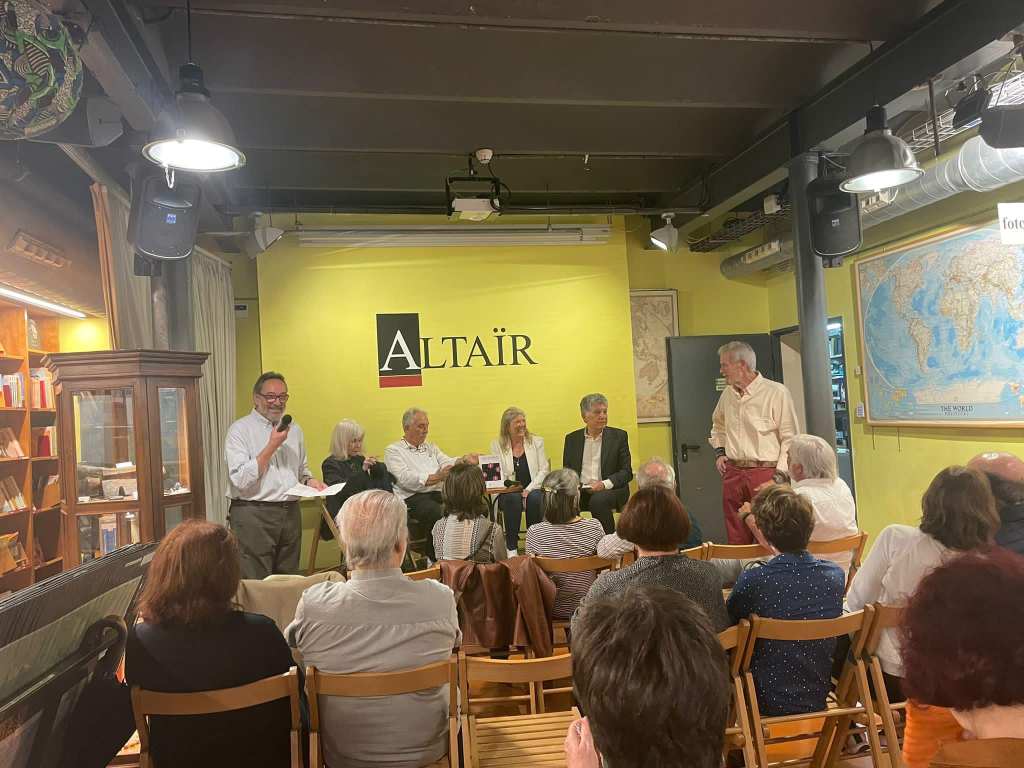
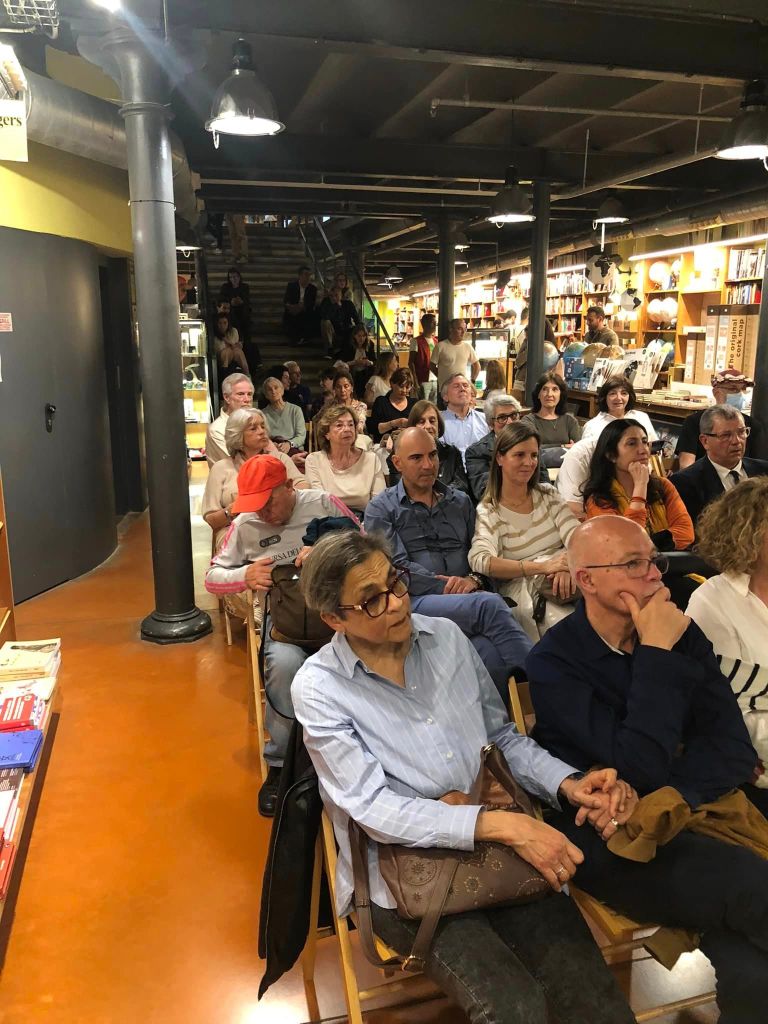
Una vez más, esta vez en Barcelona, la presentación de «Ellas y sus huellas» fue un acto muy especial. Contamos con el patrocinio de Casa del Uruguay en Barcelona, y las palabras de Pedro Zaragüeta en su nombre. Además el acto fue moderado por Rodrigo Rama, amigo de toda la vida, y comentado por la escritora Susana Frouchtmann. Nos reunimos unas 70 personas que invadieron las escaleras de la Sala de la librería Altaïr. El editor Henry Odell también nos honró con sus palabras.
Poder dedicar el libro a tantos amigos y asistentes fue una maravilla.
El 16 de febrero de este año, 2023, se presentó en la Librería América Latina el libro de relatos Ellas y sus huellas de José María Garat y Myriam Mercader. Lo presentó la escritora Andrea Arismendi y Eduardo Oddo, estando presente también el editor de Pensódrom21 Henry Odell y los autores.
Hubo una gran participación de público y el libro tuvo muchísima aceptación, vendiéndose todos los ejemplares.
La charla y análisis de Andrea Arismendi fue muy extensa e interesante.
Agradezco a todos los amigos presentes y a los comentadores y la editorial. Próximamente se presentará en la Librería Altaír de Barcelona, España-
This work studies a selection of Joyce Carol Oates’ anthology The Oxford Book of American Short Stories. The aim is to analyse the grade of implicitness present in American short stories throughout the last three centuries. Grice’s Relevance Theory and Bonheim’s Narrative Modes and Techniques of the Short Story have been taken as framework for the research.
The meaning of a piece of literature is more
than often not an obvious matter. It may lie hidden entwined in the characters
thoughts for the reader to detect or it may be just awareness on part of the
reader at a certain moment in the story, many times at the very end. This study
focuses on these hidden elements that affect intrinsic meaning, what linguists
call “implicatures”.
Implicitness in Short American Narrative
Introduction
On analysing Joyce Carol Oates’ The Oxford Book of American Short Stories as
the base for our study we encounter an outstanding selection of some of the
best and paradoxically least known American short stories. It was indeed, the
author’s intention to gather them in a collection, finding unfair that many
such an interesting story should remain practically unknown to the general
public. Joyce Carol Oates acknowledges having chosen the stories bearing in
mind storytelling as an art as well as political or social themes rather than
literary experimentation. This study will focus on the implicit ways these
themes are conveyed.
Part I of this work is a foreword on the elements considered important in the analysis of implicitness, in other words concepts relevant to our study such as implicature, explicature or narrative modes that have largely puzzled the erudite mind. Part II is entirely dedicated to the study of Implicitness under the umbrella of the distinct narrative modes and of the Relevance Theory. The Conclusion aims to outline the basic trend American short stories have followed since the eighteenth century concerning the grade of implicitness the writers pervade their literature by.
Part I – An approach to relevant
terms
Much has been written on Relevance
Theory, Implicatures, and Explicatures, but in general all linguists claim that
there is a distinction between the explicit content and the implicit import of
an utterance. Jim Meyer’s distinction in his article What is Literature? A Definition based on Prototypes is a relevant
one to bear in mind:
In
pragmatics there is an important distinction between ‘explicatures’ and
‘implicatures’ in understanding the meaning of a text. An explicature is the semantic
representation which is present in the linguistic cues of an utterance; an
implicature depends on the explicatures (the propositions which are expressed)
together with the context.
Jim Meyer makes some interesting quotations
from Diane Blakemore’s Understanding
utterances:
Speakers do not always intend to
communicate a specific set of assumptions: sometimes the speaker’s intentions
are less determinate so the hearer is simply encouraged to think along certain
lines without necessary coming to any specific conclusion (1992.168).
Every hearer (or reader) is guided
and encouraged by the text in the sense that it gives access to contextual assumptions
which yield implicatures…A creative hearer is encouraged to take a greater
share of the responsibility in the interpretation process, so that the extra
effort she invests is rewarded by a wide array of very weak implicatures, which
she is encouraged to explore (1992:172).
It is these ‘weak implicatures’ that
we intend to analyse as well as the way the writer may violate many of the
maxims Grice’s Cooperative Principle suggests as unequivocal to communicate
accurately under the four categories. Namely: under Quantity: be as informative
as required, do not be more informative than required; under Quality: make your
contribution one that is true, do not say what you believe to be false, do not
say that for which you lack adequate evidence; under Relation: be relevant; under
Manner: be perspicuous (avoid obscurity of expression, avoid ambiguity, be
brief and be orderly).
The violation of these maxims may
give place to what Meyer called ‘weak meaning’ or ‘weak implicatures’, meanings
which are present but which are less strongly present and that, sometimes,
combined with several other weak meanings may provoke in the reader the poetic
effect. Meyer also quotes Blakemore on the definition of the poetic effect “the
effect of an utterance which achieves most of its relevance through a wide
array of weak implicatures” (Blakemore 1992:157). For Meyer then, a
prototypical literary work contains many weak implicatures, so that the readers
are invited to think of many propositions which are only weakly present.
Two other terms that may deserve a
previous word are those of ‘short story’ and ‘narrative modes’. And in a way
the latter will help as a tool to understand the former. It is very difficult to define ‘short story’
most of all when it is still in midst of its development. Ian Reid tell us in The Short Story that we have to start
defining ‘story’ and only then continue with ‘short’, afterwards analyse its
evolution from the tale and note the impulse Romanticism gave to the genre
acknowledging :
..that the short story typically
centres on an inward meaning of a crucial event, on sudden momentous
intuitions, ‘epiphanies’ in James Joyce’s sense of that word; by virtue of its
brevity and delicacy it can, for example, single out with special precision
those occasions when an individual is most alert or most alone (1982:28).
Reid also points out in his fifth
chapter the ‘essential qualities’ of a short story, namely: unity of
impression, moment of crisis, and symmetry of design and, what is more,
questions their essentiality. It is not our intention to go into depth on these
matters, may they interest us as much as they do, but arrive to a close
definition which we can bear in mind while carrying out our research. For this
matter we find Joyce Carol Oates’ personal definition the most relevant, being
hers the selection of stories we are to deepen in:
My personal definition of the form
is that it represents a concentration of imagination, and not an expansion, it
is no more than 10.000 words; and no matter its mysteries of experimental
properties, it achieves a closure- meaning that, when it ends, the attentive
reader understands why..[..]..Its resolution need not be a formally articulated
statement…[..]..but it signals a
tangible change of some sort; a distinct shift in consciousness, a deepening of
insight. (7) [1]
James Joyce, Ian Reid,
Joyce Carol Oates, and many others, have realized that it was conflict and the
reader’s awareness of it all, no matter if suddenly experienced in an
“epiphanic” moment or through pages of swift consciousness, that generated a
piece of literature and therefore a short story.
Helmut Bonheim through his analysis
of The Techniques of the Short Story arrived
to the conclusion that some narrative modes have been more popular in one age
than in another. Bonheim starts his first chapter saying that “Even the
shortest of story forms, the anecdote, tends to use all of the chief modes of
narrative” (1992:3) which he later defines as description, report, speech and
comment. For Bonheim these four modes are “the staple diet of the short story
and the novel” (1992:3). But not in all ages the hierarchy of modes has been
the same:
“In our age speech stands high in
the esteem of most readers. Description is thought boring except in small
doses; comment of a particular kind, namely moralistic generalizing, is almost
taboo, even where imbedded in speech; and even report is preferred in the dress
of, or at least heavily interlarded with, speech.(1992:8)
Society’s tastes during a determined
period will be reflected in its literature and the study of short stories will,
no doubt, show us the same trend. For Bonheim a short story is:
“an amalgam, usually an unbalanced
one, of the four modes : whereas Irving’s story consists of description and
comment, these modes may be absent from stories written about a century later,
such as Katherine Mansfield’s “Theft”, which contains the other two modes
almost exclusively” (1992:14).
Part II – Implicitness in a
Selection of the Short Stories in Joyce Carol Oates’ Anthology.
In our days general literature
criticism believes that the writer should intrude as little as possible in the
reader, what Joseph Warren Beach called “exit author thesis” in The Twentieth Century Novel, Studies in
Technique (1932:14), but during the 18th and 19th century this was not so. The fashion then
indicated that the author could be very explicit in his comment and therefore
the most popular modes were report and comment.
Following a chronological order in
our selection, we first find Rip Van Winkle. Irving’s last sketch of his Sketch
Book has hardly got any speech at all – except for the middle part of the story
– but a lot of comment, description and report. Irving makes use of a series of pseudonyms
which act twofold: as a twinkle to the faithful reader, who will remember his
previous publicity campaign, and as a way to give his story authenticity. The
story is supposed to have been first told by Rip Van Winkle himself, written by
D. Knickerbocker as a true story and finally discovered by Geoffrey Crayon.
This introduction may also recall Cervantes’ introduction to Don Quixote where
he intends to assure accuracy. The interference of the writer is clear and very
characteristic of the time. The story itself starts with a long description of
the Kaatskill Mountains and with the author addressing
directly the reader: “Whoever has made a voyage up the Hudson, must remember the Kaatskill
mountains. They are a dismembered branch (……) At the foot of these mountains,
the voyager may have descried the light smoke curling up from a village” (18). What
further characterises the opening of this story is that the description will
not really be relevant to the plot, what would be considered out of place in a
modern story. Irving
continues his story with a report of Rip’s character and his falling asleep to
wake up twenty years later. It is only when he wakes up that the author’s
intentions come to surface. Towards the middle of the story, here also helped
with speech, Irving
reveals that Rip has awakened being part of a Republic and not a subject of the
King of England. In his quest for identity, Rip symbolises America’s own
quest; his divorce from the past may well be America’s denial of her British
past. There are very ‘explicit’ symbols like the sign on the tavern which had
been disguised as George Washington, but could still be identified by Rip as
“the ruby face of King George, under which he had smoked so many a peaceful
pipe” (27) The story ends with one of its many samples of humour and irony: “it
is a common wish of all henpecked husband [..] that they might have a quieting
draught out of Rip Van Winkle’s flagon”.(32)
William Austin, in his Peter Rugg,
The Missing Man, makes use of a similar strategy to put forward his tale as a
letter form Jonathan Dunwell of New
York to Mr. Herman Krauff and to reassure, therefore,
its authenticity. Austin, nevertheless, alternates report with speech and
comment making his story much more ‘modern’, although it has also got a lot of
explicit symbolism. This old yarn had been long told as a nursery tale and
later was forgotten for a long time. Austin
like Irving at
the end of the story includes a “Further Account of Peter Rugg by Jonathan
Dunwell” advocating for its veracity.
Here we find out that after having been running for years to find his
home, without being successful because he had defied Nature with his cursing,
he arrives to find his house burned and its land auctioned. The story is a
parable and as Irving’s
has also to do with Time. The Further Account finishes with an “explicit”
explanation:
Then spake a voice from the crowd,
but whence it came I could not discern. “There is nothing strange here but
yourself, Mr. Rugg. Time, which destroys and renews all things, has dilapidated
your house, and placed us here. […]..Your home is gone, and you can never have
another home in this world.” (61)
Both Irving’s and Austin’s tales are
about a subject that has always fascinated men: Time, though the way they make
use of it may differ in intention and in form.
The Wives of the Dead follows the
same line, starting Hawthorne
the story addressing the reader “The following story, the simple and domestic
incidents of which may be deemed scarcely worth relating..”(63) It directly
starts informing the reader of an incident that though it may seem
insignificant it had aroused interest and for some reason or other, and one immediately
hopes for the best. The comment and
report on the part of the author will continue all through the story embedded
even in descriptions of the sort: “Her sister-in-law was of a lively and
irritable temperament, and the first pangs of her sorrow had been expressed by
shrieks and passionate lamentation.” (64) The descriptions will leave little to
the imagination of the reader and almost no implicit elements will be found
throughout the story. On the other hand, it has, as almost all Hawthorne’s stories, a lot of moral content, especially
concerning the well-natured sisters-in-law who, believing each to be the only
one to have her husband alive, behave so unselfishly as to delay telling the
other in order not to make her suffer. The author is always very present even revealing
the thoughts of the characters in the form of direct monologue “My poor sister¡
you will waken too soon from that happy dream,” thought Mary”.(68) What strikes,
for the first time in the story to the 21st century reader is the
last paragraph which leaves the final outcome open, “Before retiring, she set
down the lamp and endeavoured to arrange the bed-clothes, so that the chill air
might no do harm to the feverish slumberer. But her hand trembled against
Margaret’s neck, a tear also fell upon her cheek, and she suddenly awoke.”(68) This
paragraph also supplies an example of “implicature” with this tear that also
fell, telling us that in her anxiety the young wife had also wept. We are left
to imagine the following development of the scene leading towards the final
discovering on the part of both sisters-in-law that the other knew of their
husbands being still alive, or, as a more suspicious reader may suspect, one of two informers could not have told the
truth and the story could lead elsewhere had it been written. A final word can
be said on the last “she awoke”. Could it not have been Margaret, but Mary? She
might as well have been dreaming.
If we turn to Herman
Melville and his The Paradise of
Bachelors and the Tartarus of Maids, we encounter a prose that sounds much
more familiar to the modern reader. To start with the story breaks out with an
initial “It” that the reader will not fully understand until the end of the
second long paragraph, thus violating one of Grice’s maxims, and making the reader
keep on with curiosity: “It lies not far from Temple Bar. Going to it, by the
usual way, is…” (70) The reader will also be intrigued about this ‘usual way’
which he is supposed to recognise. The technique was not very much extended in
Melville’s time and it violates Grice’s Cooperative Principle maxim “Be
perspicuous” The story is full of implicit meaning. It was the beginning of
industrialization which, as it stood, was against the incipient democratic
principles and Melville denounces it in the story. The two parts of the story
represent the two worlds: the wealthy capitalist class that produced nothing
and just lived an empty life “of quiet absorption of good living, good
drinking, good feeling and good talk” (76) – a men’s world and heaven – embodied
by the Bachelors- and the other, the maid’s world and hell which incarnate
wooing maids, young girls chained to a machine that dehumanize them and make
them as white as the paper they manufacture. With this paper the lawyers will
earn their money, bachelors will abuse maids, capitalist will control workers.
The way the story is narrated, almost as if it were two different stories, is
revolutionary for the time and indicates the gap between the two social
classes. It may even indicate a feminist defence on the part of the writer “The
girls,” echoed I glancing round at their silent forms. “Why is it, Sir, that in
most factories, female operatives, of whatever age, are indiscriminately called
girls, never women?”(89) For the bachelor that governs them women must be like
“mares haltered to the racks” and not allowed to have children or husbands that
would only disturb them. Their forms are silent, unable to fulfil their natural
development. The guide lad, Cupid, relates it all to the visitor, as if it were
joke on the part of the writer on the interrelation man/woman. The final
exclamation: “Oh¡ Paradise of Bachelors and Oh¡ Tartarus of Maids” (90) unites
both worlds in the character’s mind giving them their real importance,
realizing that the paradise he earlier praised was on account of the hell of so
many. It is what modern criticism would call an ‘epiphanic’ moment.
Edgar Allan Poe’s mad character in
the Tell-Tale Heart begins addressing in the first person the reader as if in a
conventional chat: “True¡ nervous, very, very dreadfully nervous I had been and
am; (….) You fancy me mad. Madmen know nothing. But you should have seen me.” He
will continue trying to convince the reader he is not mad and by the mere fact
of doing so and telling how he killed the poor old fellow, because he could not
get rid of the look of “his Evil Eye”, he convinces the reader of the contrary.
Poe creates the ambiance and masterly
leads the reader to the final outburst of madness by means of a continued insight
of the character’s mind. The mind of a man or a woman, we do not know because
Poe uses “I” or “me” that is driven mad by the fear of the power of an evil eye
which he finally cannot escape.
The Storm is a master piece by Kate
Chopin which leaves little for the reader to imagine. It is one of the most
explicit stories of marital deceit with a happy ending in the story of American
literature and, what is more, with no sense of treachery on the part of the
actors. “The generous abundance of her passion, without guile or trickery, was
like a white flame which penetrated and found response in depths of his own
sensuous nature that had never yet been reached”.(133) The writer goes a bit
further stating that it was her flame that penetrated him and taught him what
he still did not know. In a time, when women had to be aloof from all sexual
desire, not to say of the actual knowledge of sex, The Storm could not have been but ignored by all publishers as it
actually was. The metaphor of the storm depicts Calixta’s passion which when
put off leaves her feeling even a better wife. Both couples are explicitly told to be at ease
at the end of the story: “So the storm passed and every one was happy.”
The Yellow Paper by Charlotte Perkins Gilman may be considered the opposite of The Storm if we discuss implicitness.
There is so much implicit that still nowadays the story is being analysed and
interpreted on different levels, namely psychological, sociological or
feminist. There is a lot to be interpreted. Only some examples are cited below.
From the very beginning, the narrator names herself only with pronouns: myself,
me, one, I. This has been interpreted by many authors as
a way to disguise her identity under a veil of anonymity which could include
many other women in the same condition. When the narrator uses her name, it is
only at the end of the story and in the third person when she has become the
other woman, the one which has escaped from the yellow paper and is addressing the
husband. “I’ve got out at last,” said I, “ in spite of you and Jane.(169) She is no longer Jane, she is “I”. The yellow
paper symbolises the oppressive situation many women lived in at a time, when
post-partum depression was considered an mental illness and women were
prescribed isolation and immobility by male doctors, which many times drove them
to real madness. Gilman depicts how a woman can finally get beyond the yellow
paper defying men’s power. ”And I’ve pulled off most of the paper, so you can’t
put me back¡” Now why should that man have fainted? But he did, and right
across my path by the wall, so that I had to creep over him every time¡”(169) In
the ending to the story it is the liberated woman that speaks, even if she is
on her hands and knees, she keeps creeping over the fainted man. Her husband faints because he cannot stand
her half disobedience, or because he cannot consciously accept not having full
power. The reader must make his own conclusions.
The Middle Years by Henry James is the story of an artist, a writer who achieves high
quality art when he is about to die and cannot accept not having a further
chance to continue with it now that it was finally in his possession. “The art
had come, but it had come after everything else. At such a rate a first
existence was too short-long enough only to collect material; so that to
fructify, to use the material, one should have a second age, an extension. This
extension was what poor Dencombe sighed for.” (174) James’ personal realism,
which depicted his character’s inner experiences not merely life as seen in a
mirror, works here very well. The writer by means of the character’s inner
thoughts will keep us informed of almost everything. There is little implicit
but we are taken by the hand of the author from beginning to end. Dencombe
laments his almost lost life very early in the story foreshadowing the last
sentences ”Frustration’s only life,”
said Doctor Hugh. “Yes, it’s what passes.” Poor Dencombe was barely audible,
but he had marked with the words the virtual end of his first and only chance.”
(189) This mixture of speech and comment on the part of the writer will close
an ending which otherwise would have remained a little more open and nearer to
21st century taste.
Even more explicit is Jack London’s In a Far Country where the author in his
celebrated two first paragraphs gives the reader a lesson of good behaviour
when leaving the well-known domestic world to venture into the unknown natural
world “For the courtesies of ordinary life, he must substitute unselfishness,
forbearance, and tolerance.” Making use of report and comment Jack London will
lead the reader till the end of the story where both characters kill each other
after incurring in almost every capital sin. There is very little speech, just
some thought in the third person narrator:
Well he would have company. If
Gabriel ever broke the silence of the North, they would stand together, hand in
hand, before the great White Throne. And God would judge them, God would judge
them¡
Then Percy Cuthfert closed his eyes
and dropped off to sleep.(205)
Old Woman Magoun by Mary E. Wilkins (Freeman) has relatively more speech than report or
comment. It is a cry in favour of women and mostly coloured women. “The
weakness of the masculine element in Barry’s Ford was laid low before such
strenuous feminine assertion” (207) The
reader of the story – if not familiar with the author’s tales – will not know
but for the language used by Old Woman Magoun that she is a coloured woman.
Neither is he told that Lily is the daughter of a black woman and a white man.
It is nevertheless implicit “She’s got a
good color” said Sally Jinks…(…)…”I know she’s got a beautiful color,” replied
Old Woman Magoun, with an odd mixture of pride and anxiety, “but it comes
an’goes.” (210) The beautiful colour and the mixture of pride and anxiety
implies all the horror that lies under the life of a mulatto girl (though we
are made aware of her blondness) whose grandmother knows better than let her
grow up because she foresees an unlucky destiny in the hands of a loathsome
white father. The episode of the berries which on the way to Greenham Lily is
forbidden to eat foreshadows the final outcome as, later on, on the way back
after having been denied the adoption which could have been the only salvation,
the girl is almost induced to eat, though in a silent manner. The author does not explicitly tell us what
is in Old Woman Magoun’s mind, but she leaves it very clear with the single
sentence “Come” she said, “it is time we were going. I guess you have set long
enough.” (221) The girl has had enough poisonous berries and she will be freed
from her terrible destiny of being given away as payment for gambling debts.
While getting closer to our time in
our chronological journey through the anthology, we begin to encounter more and
more implicit literature, less comment, more speech, and increasingly more
ordinary characters who, notwithstanding, will in their quest for identity
experience what any human being is deemed to experience: conflict and a moment
of illuminating awareness. Often these characters will feel that life is an
endless abyss of nothingness. On this line Ernest Hemmingway’s A Clear Well-Lighted Place is one of the
best examples of economy of words and comment but of profound enlightening on
the eternal dichotomy between the young and fearless man and the more mature
and sadly knowledgeable man who has finally realized there is “nada : pues
nada” (299) to pray for. Hemmingway uses only two short paragraphs, the first –
a description – and a middle one, in the form of interior monologue, to give
the reader some explicit clues on the characters’ thoughts. The rest – mostly
speech – serves to depict masterly the two worlds.
In The Strength of God, Sherwood Anderson’s Presbyterian minister also
experiences this moment of sudden awareness that functions as a high-pressure
valve through which all the repressed sexuality will give way to the appearance
of God in the form of a naked school-teacher kneeling on a bed. Basically the
story contains report and comment and the repressed thoughts of the only
character. It is not until the end of the story that he addresses a second
character, George Williard, to tell him how God gave him the strength to smash
the window through which he spied the woman. But this second character will not
utter a single word in response:
“I have found the light” he cried.
“After ten years in this town, God has manifested himself to me in the body of
a woman.”…..(….)..I am delivered. Have no fear…(…) “I smashed the glass of the
window,” he cried. “Now it will have to be wholly replaced. The strength of God
was in me and I broke it with my fist”. (263)
F. Scott Fitzgerald mastered another
character-maybe because he had had the same suffering- who felt lost in the
abyss of a wasted life. An Alcoholic Case
shows two characters that though sympathising one with the other are jointly
incapable of beating death. Death appears in a corner of the room, and both the
nurse and her ‘case’ feel it. ‘..she
knew that death was in that corner where he was looking’.(309) Discouraged the
nurse will explain, the day after, to her boss ‘It’s not like anything you can
beat’ …(…)..it’s so discouraging –it’s all for nothing”.(309) Once again there
is ‘nothing and then nothing’. With the use of ‘it’ and ‘anything’, of undetermined
intrinsic meaning, the author implies that which the nurse is not able to put
into words but the reader will perfectly grasp, thus violating all of Grice’s
Cooperative Principle maxims.
William Faulkner, the most original
writer of his day, almost re-invented fiction. He’s marvellous technique
enhanced him to talk in the voices of every kind of character. In That Evening Sun the eternal tragedy of
black people in the States is shown indirectly through the voices of the
children of a white American family (its member will appear again in The Sound and the Fury published later).
Through the incoherent chattering of the smaller children and a couple of
assertions on the part of the father and Quentin, his nine-year-old daughter
and first person narrator of the story, we learn the details of a frequent case
of abuse to black women by white powerful men. Jesus, the black woman’s husband
takes revenge in the person least guilty but most accessible: Nancy, his wife. “I
just a nigger. It aint no fault of mine”.(350) Nancy’s moaning has all the tragedy implicit.
She is not to blame but just accept her fate. After leaving Nancy alone in her cabin waiting for her
destiny, Quentin’s question clears the reader’s doubts: “Who will do our
washing now, Father?” I said. The matter is already settled and now the family
has to look forward to their immediate needs, even a nine-year-old is aware of
it. Faulkner mastered the economy of words and this “who?” is not questioning
but really answering.
Richard Wright, less innovating but
as reaching, depicts in The Man who was
almost a Man another tragedy another black abuse. The reader together with
the character, a fifteen-year-old black boy, will realize simultaneously at the
time of hearing the sound of a train approaching, that the boy had been cheated
into a-two-year slavery: “Two dollars a mont.
Les see now…Tha means it’ll take bout two years. Shucks¡ Ah’ll be dam¡” (383) The
reader is left running away with the boy after catching a train “away to
somewhere, somewhere where he could be a man”.(383) Here, once more in literature, an indefinite
pronoun stands for the staple of modern society.
It is no coincidence that the first
chapter of another memorable book starts: “It goes a long way back, some twenty
years. All my life. I had been looking for something, and everywhere I turned
someone tried to tell me what it was.”(441)
This is how Battle Royal, the
first chapter of Ralph Ellison`s Invisible
Man, begins. Here we encounter another black writer, but essentially the
same character running after his identity and after success. Ellison’s
character, does not have a name, he embodies all negro boys. The story is written
in the first person singular and the reader does not have a clear picture of
the narrator but the events narrated foreshadow what fate he will suffer. The anecdote
of his grandfather will also serve as a device showing the boy the way to
follow “Grandfather had been a quiet old man who never made any trouble, yet on
his deathbed he had called himself a traitor and a spy, and he had spoken of
his meekness as a dangerous activity” (442) The remembrance will haunt him all
his life and it is explicit at the end of the chapter in the form of a dream
where his grandfather writes “Keep This Nigger-Boy Running”.(445) He
acknowledges not having at the time an “insight into its meaning”. So the
chapter starts as it finishes with a search for identity and this endless
running after self-assurance.
Human eternal quest seems to have a
tragic ending in Ray Bradbury’s Three Will
Come Soft Rains. It is a terrible future of nuclear war that mankind should
avoid. There are many interesting features in the story as personification to
describe the house’s actions, that
continues to function as if nothing had happened. The house is afraid, though, and that fright
is reasonable because the family is gone though “their images burnt in wood in
one titanic instant” (458) can yet been seen. The writer does not inform the reader
immediately of the facts but goes little by little drawing the picture. The
title of the story, the poem chosen by the house to be said –not precisely at random – parallels the story
up to the final outcome: “And no one will know of the war, not one will care at
last when it is done. No one would mind, neither bird nor tree. If mankind
perished utterly” (460) It is precisely the falling of a tree that will cause
the final disappearance of the house under the fire. Then everything collapses and leaves us one last
voice “Today is August 5,
2026, today is…”(462) and hoping it would not be premonitory.
For the last part of the anthology
Joyce Carol Oates selected several stories by contemporary writers, many of
which belong to ethnic or social minorities, that have progressively had more
and more echo in society and whose vindications are conveyed in their
literature masterly and growingly elliptically.
Leslie Marmon Silko is one of them
and Yellow Woman one of her best
stories. As many of her contemporary writers, she does not openly speak in her
literature but her message is implicit in depths in her stories. Hers is the
voice of many Native Americans and it brings up issues of personal identity,
cultural identity, and genre identity. The story is told in the first person
singular and the narrator loosens herself to gradually believe she is Yellow
Woman, part of myth and tradition and therefore free to live her sensuality
without guilty feelings. But there is much more to the story if closely
studied. With the frequent mention of dampness, heat, warmth in connection with
the narrator’s senses, the author is linking Mother Creator with her siblings. “My thigh
clung to his with dampness…[…]…I cleaned the sand out of the cracks between my
toes…[…]…I felt hungry…” (592) The land and the woman are all one, the narrator
begins to feel part of tradition too, she wonders “if Yellow Woman had known
who she was…[…]..Maybe she had another name. (493) Later Silva will tell her “ But some day they will talk about us, and
they will say “Those two lived long ago when things like that happened.” (595)
“Stella, cold, cold, the coldness of
hell” This is the beginning of Cynthia Ozick’s story The Shawl. This seven words foreshadow the hell to be lived by the
main character, Rosa , as well as depicts the
character of Stella, her condition of being terrible cold and the ultimate
reason of Rosa’s child death. The title of the story the ‘shawl’ also
functions as a symbol: it will first serve to hide Magda – Rosa’s
baby – from the Nazis and later stop her from screaming when she actually
watches the child die. In the story we first encounter coldness, naked, harsh
words but gradually the author will impregnate them with a poetic scent “All at
once Magda was swimming through the air. The whole of Magda travelled through
loftiness.” (605) The words describe the instant previous to the child’s death
against an electrified fence in a Nazi concentration camp. How else could it be
beared?
David Leavitt’s Gravity has lots implicit in the title too. Gravity is what has to
be beaten to prove human consistency. There is no direct reference to AIDS in
the story nor to HIV+ but it is very well implied as for example in the
incident of the two salesmen who refuse to shake Theo’s hand. The title is echoed in “It seemed Sylvia had
been looking a long time for something like this, something heavy enough to
leave an impression, yet so fragile it could make you sorry.” The
impression would be left, not only in Bibi but also in Theo who will
realize that – no matter what – he could still mark a difference, impose his
being and by doing so help both his mother and himself to “win some small but
sustaining victory” (745).
Today’s writer has no other choice
than to provoke with literature sudden revealing moments, epiphanies, ‘titanic
instants’ because today’s conflicts are otherwise unspeakable; perspicuousness
too flat.
Perspicuous writing is also too
limited for Sandra Cisneros. Her stories, almost poems, are like photographed
instants, exquisite life portraits that elliptically tell us about Latino
community in North America and its terrible
circumstances. A house of My Own for
example, consists of only two paragraphs, one of them only a sentence “Only a
house quiet as snow, a space for myself to go, clean as paper before the poem”.
(749) and yet encompassing so many “weak implicatures”.
Finally, a word on Heat: our author’s own contribution to
her anthology. Oates expresses in the foreword to the story that “For the
author, the formal challenge of Heat
was to present a narrative in a seemingly acausal manner, analogous to the
playing of a piano sans pedal, as if
each paragraph, or chord, were separate from the rest” (607). She thoroughly accomplishes
the challenge. As J. Alan Rice noted in
his detailed study Chord Structure in
Joyce Carol Oates’ “Heat” (1995), Oates “means that the narrative has been
pared down to its essentials”. Her intention being to diminish it gradually
until it is understood as unique notes “without sustaining notes from one chord
to another” asserts Rice. “But the most important aspect of the structure of
“Heat” is that the final chord, that which the story is about, is missing.” Once again how could something as despairing as
the raping and murder of two girls else be told?
Conclusion
The success of a piece of literature
is parallel to its success in reaching each and every reader. The best way to do it will depend on the
artist’s expertise and sensibility. There are no predetermined rules and the
history of literature endorses it, but, many times, to convey meaning on part
of the writer or to apprehend it on part of the reader is no easy task; it
implies alertness on both sides. In
Joyce Carol Oates’ own words: “Because the meaning of the story does not lie on
its surface, visible and self-defining, does not mean that meaning does not
exist. Indeed, the ambiguity of meaning, its inner, private quality, may well
be part of the writer’s vision.” (8)
From the 18th century up
to our days storytelling has experienced notable changes. Far back in time have
the parables with moralistic comment been discarded. Detailed description and
lengthy report have also suffered a continuous metamorphosis evolving to more
and more succinct speech, at times only images, the meaning of which the reader
is merely invited to seize.
Notwithstanding this evolution,
nothing is definite. Storytelling is a long winding road; a multi-dimensional
road along which Society can trek, develop, progress and be substantially
represented while led in its eternal quest for identity.
Works Cited
Beach, Joseph Warren. The Twentieth Century Novel: Studies in
Technique. New York.
The Century Co., 1932.
Bonheim, Helmut. The Narrative Modes: Techniques of the Short
Stories. Cambridge.D.S. Brewer. 1992
Grice, H.P. Pragmatics: A reader. Oxford
University Press. 1991.
Meyer, Jim. What is Literature? A Definition Based on Prototypes. Work Papers
of the Summer Institute of Linguistics. University of North Dakota.
41: [33-42].1997.
Oates, Joyce Carol. The Oxford
Book of American Short Stories. Oxford
& New York
: Oxford University Press. 1994.
Reid, Ian. The Short Story. Methuen & Co. Ltd. New York. 1982.
















 El blog de Myriam M. Mercader